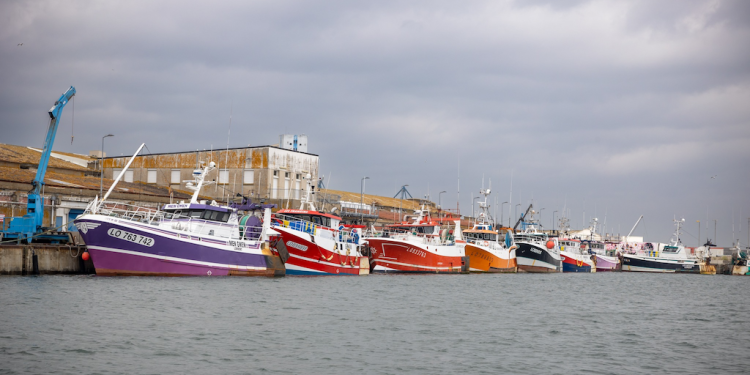





Despite being reduced in scope, a planned wind farm off the Brittany coast near Roscoff will marginalise commercial fishing, according to the Brittany Regional Fisheries Committee which claims around fifty active fishing vessels will be affected.
‘With the choices that have been made regarding offshore wind power, we are faced with a plan that does not reflect the reality of marine uses,’ said CRPMEM president Olivier Le Nézet.
‘In the two previous planning phases, a compromise was reached between energy sovereignty and preserving fishing opportunities as much as possible.
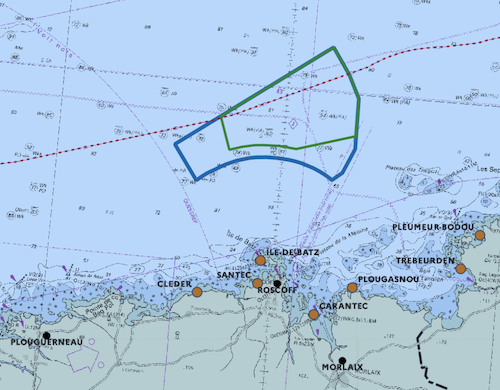
Plans for the wind farm off Roscoff and a projected extension south of Belle-Île by 2035 were presented at a conference in Rennes. Although the scope of the plans have been scaled back from 2gW to 1.2gW, the industry is adamant that despite their active participation in the public debate and proposals, the realities of commercial fisheries have not been taken into account, posing a direct risk to the activity of around fifty vessels.
The Brittany Fisheries Committee already filed an appeal in 2025 against the choice of the proposed site, stating that this area is used by around fifty Breton fishing vessels, some of which are highly dependent on it and given the constraints of coexistence in the Western Channel, the possibilities for relocation are virtually nil.
The industry’s position is that the planning project that was too biased from the outset and failed to consider commercial fishing, even though the first Coastal Strategic Document considered this activity to be a fundamental element.
‘Off the coast of Roscoff, in the Northwest Brittany region, the offshore wind farm as currently planned directly affects around fifty vessels and the corresponding fishing effort as defined by the Common Fisheries Policy, with no alternative fishing grounds available to them,’ said former Roscoff crab fisherman Yannick Calvez, now president of the Finistère Departmental Fisheries Committee.
‘Despite our active participation in the public debate and our efforts to identify areas with fewer constraints, our proposals were rejected.’
According to the Committee, the remaining long-term challenge is the coexistence of fishing vessels and wind turbines. While the Saint-Brieuc Bay site reopened to fishing in the summer of 2024, after several years of work, these were fixed, stationary wind turbines – while the situation is different for floating wind farm projects. A study by the Brittany region does not rule out co-activity with certain types of floating wind turbines. But the Brittany Fisheries Committee’s concern that co-activity will not allow for maintaining current levels of activity.