



Now active in over 20 countries and territories across all tropical tuna oceans, ReCon has established itself as the largest circular economy initiative for recovering and reconditioning fishing devices, giving them a second life to support science, small-scale fisheries and ocean conservation.
ReCon just landed in the Caribbean, through a partnership with Ripples to Waves, a grassroots NGO from St. Vincent & the Grenadines dedicated to ocean conservation through science, experience-based education and art. By joining ReCon, Ripples to Waves will not only give new life to recovered fishing beacons but also join the efforts of the One Drop in the Ocean marine debris initiative to raise awareness concerning marine debris, entanglement and the effects it has on marine life and our coastal communities.
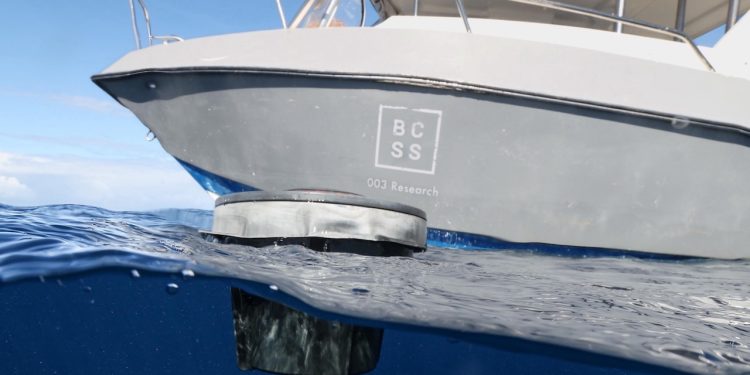
ReCon is also reinforcing its presence in the Western Indian Ocean (WIO), where long-standing partner Bazaruto Center for Scientific Studies (BCSS) in Mozambique – operator of a permanent Ocean Observatory in collaboration with Kisawa Sanctuary – has expanded its work into Tanzania, Kenya, Madagascar, and South Africa. This broader collaboration allows for increased buoy recovery and reuse, while fostering community engagement and partnerships with fishers and local organisations.
‘Real-time ocean data feeds are transforming conservation; and with Satlink technology, we are turning science into action. Partnering with Satlink allows us to bring real-time ocean intelligence into the heart of marine sciences,’ said Dr. Mario Lebrato, Manager of the Ocean Observatory at BCSS.
‘By harnessing live data streams, we can now track biodiversity, species richness, and ecosystem change as it happens, turning science into immediate insight. In a time of accelerating environmental pressure, this is the kind of bold, practical innovation the blue economy needs. We are proud to be building that future together with Satlink.’
Launched in 2022 in partnership with the Australian NGO Tangaroa Blue Foundation and the Australian Marine Debris Initiative, ReCon works closely with the fishing industry and leading environmental organizations to prevent buoys from becoming technological waste. Once reconditioned, these smart devices are repurposed for a wide range of scientific and conservation uses, including oceanographic research, marine debris tracking and monitoring, small-scale fisheries and early warning systems.
‘Project ReCon is proving that collaboration can drive real change in ocean sustainability,’ said Kathryn Gavira, head of science and sustainability at Satlink.
‘By giving this fishing technology a second life, we are not only reducing waste, but setting a new standard for how industry, science and communities can work together to protect and better understand our oceans.’