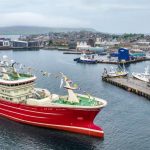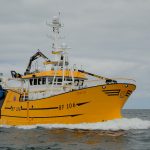
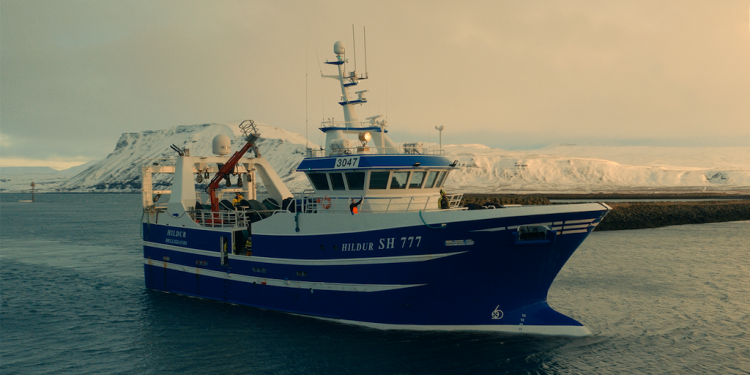





Seine netter Hildur SH-777, operating from Rif in the west of Iceland, has been using an OptimICE (CO2) system as a key component of its catch handling system.
Formerly Pia Glanz, Hildur was acquired from Denmark a couple of years ago to replace an older fishing vessel with more modern technology. Now working mainly day-trips for cod and haddock, some changes were made when Hildur came to Iceland, with the catch handling deck refitted at the Slippurinn yard in Akureyri and a new ice system from Kapp installed.
KAPP’s CO2 OptimICE systems use a 100% CO2 refrigerant and is designed to combine high chilling performance with lower environmental impact and lower operating cost.
It’s an operation that focuses on quality to ensure that catches are chilling evenly so that freshness, texture, and product quality are preserved all the way through landing, processing, and export – a working environment that leaves no leeway for delay or inconsistency.
Before the OptimICE system was fitted, conventional ice demanded more manual work and resulted in a slower chilling process on board.
The slurry ice provided by the KAPP installation ticks all the right boxes. As well as taking out much of the heavy lifting, it’s more effective in chilling the catch as the slurry flows between layers and into spaces that regular ice cannot reach in the same way – so cooling is faster and more even.
‘It covers every square centimeter of the fish,’ said Hildur’s chief engineer Jón Kristinn Guðbjartsson, while second engineer Guðmundur Ragnar Guðmunduson commented that the most immediately visible advantage is time.
‘We are much quicker getting the fish down to roughly about zero, which preserves the meat and fish very, very well,’ he said.
When fishing is heavy, Hildur’s crew can be handling significant volumes on board, and the system has to maintain output without compromising quality or workflow. This consistency is crucial. When things are moving fast, they need a system that runs all day and the OptimICE has met all the demands placed on it.
Hildur is not just using OptimICE – it’s working with one of the first CO2-based OptimICE systems.
That matters because refrigerant choice is becoming an increasingly important part of the conversation around responsible cooling. KAPP’s CO2-based OptimICE slurry ice machines are designed to reduce carbon footprint while also reducing operating costs. The company also states that replacing a refrigerant such as R-449A with CO2 lowers Global Warming Potential (GWP) from 1397 to 1.