




A pioneering pilot project has launched in Cape Town that could revolutionise the way fishing nets are recycled in South Africa. Spearheaded by non-profit company OCEAN Action Network (OCEAN) and Ocean Plastic Technologies (OPT), the project introduces the country’s first harbour-based facility for recycling fishing nets, located at the V&A Waterfront’s Collier Jetty.
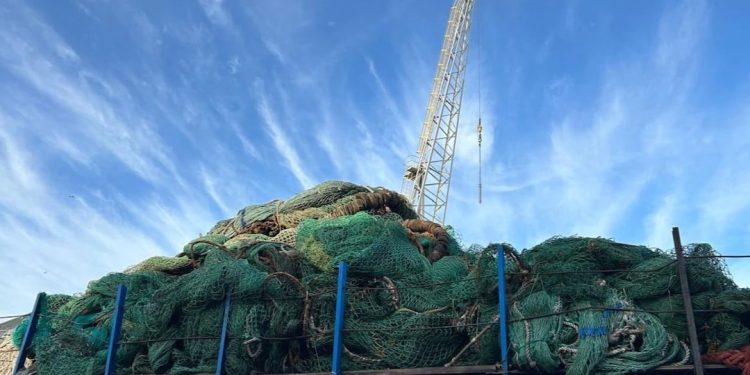
The initiative comes in response to growing environmental pressure and Marine Stewardship Council (MSC) requirements for sustainable fishing practices, including the responsible disposal and recycling of fishing gear. Despite the visible accumulation of old nets across the industry, the exact volume being discarded remains unknown as most ends up in landfill.
The pilot project at the V&A Waterfront is one of three components to be funded by a £25,000 (about R610,000) grant from the MSC’s Ocean Stewardship Fund. The grant was awarded to the South African Deep-Sea Trawling Industry Association (SADSTIA) for forward-looking research in sustainable fisheries management. The V&A Waterfront has donated the space for the project on Collier Jetty.

‘For the past three years, I’ve been talking to the industry about finding a solution,’ said Estelle van der Merwe, project lead from OCEAN. ‘The support was always there, but the challenge was logistics – baling, storage and finding appropriate processing technology. That changed when Oliver Nudds and Thomas Hansen at OPT came on board.’
OCEAN was founded by Estelle who has been active in the fields of oiled wildlife response, combatting illegal, unreported and unregulated fishing and various Antarctic and environmental issues for more than two decades. She has worked with SADSTIA and fishing companies I&J, Oceana and Sea Harvest since 2022 to find a recycling/upcycling solution for end-of-life fishing nets.
OPT, founded in 2016, specialises in micro-recycling solutions housed within repurposed 20- and 40-foot shipping containers. These recycling pods include equipment for shredding, washing, drying and granulating plastic waste, turning it into high-value, raw materials. Their model focuses on community empowerment and traceability, using blockchain-based apps to track the origin and flow of materials.
‘This is the first on-site recycling facility for fishing nets in South Africa, and possibly the world,’ said Oliver Nudds of OPT. ‘Traditionally, nets are shipped to large centralised facilities for processing. What we’ve built is a self-contained, modular unit that brings the solution right to the source.’
The recycling pod at Collier Jetty is capable of processing 100kg of nets per hour. These aree shredded, undergo a rigorous four-stage washing and drying process, and be transformed into clean, 20 mm plastic flakes. They will be processed by polymer type (typically HDPE or polypropylene) and prepared for resale. Because the material is cleaned and densified, it no longer counts as waste, simplifying logistics and significantly increasing its resale value.
‘What sets our system apart is the densification,’ he added. ‘You can fit nearly 37 tonnes of shredded plastic onto a truck compared to 17 tonnes when transporting bales. This reduces transportation costs and emissions while maximising value.’
The project is designed with scalability in mind. The containerised format allows for quick replication along other parts of South Africa’s coastline. If needed, capacity can be doubled by simply adding another container.
From a sustainability perspective, the benefits are twofold: the fishing companies save money by avoiding landfill fees and gain measurable data to support environmental, social and governance compliance and extended producer responsibility compliance; local communities, in turn, gain employment and ownership as operators of the pod through a cooperative model that sees profits from recycled material shared locally.
Estelle van der Merwe emphasised the importance of education, monitoring and sustainability tracking. A small, trained team of operators will run the pod, with additional support from OCEAN to manage logistics, financial planning and reporting. Regular data on net recycling volumes will be shared by OCEAN with participating companies, culminating in a detailed year-end sustainability report for government and MSC reporting.
‘There’s also an educational element,’ she said. ‘The V&A Waterfront is excited about this project and has requested that we provide guided tours to showcase the facility’s innovation to tourists and visitors.’
Another major benefit of the initiative is the retrieval and recycling of ghost nets, as with a proper system now in place, skippers will be incentivised to retrieve lost nets rather than abandon or discard them at sea.
The long-term goal? A self-sustaining, replicable model that transforms fishing net waste into opportunity, benefiting both the environment and local communities.
‘This is more than recycling,’ Oliver Nudds commented. ‘It’s about building a circular economy at the harbour’s edge – and it’s just the beginning.’