






There has been explosive growth in demand for sushi among US consumers, according to the National Fisheries Institute (NFI) Sushi Council which has released of the US Sushi Industry Report, a first-of-its-kind, comprehensive analysis of sushi’s expanding footprint across retail and foodservice channels and the key trends driving its continued growth.
The demand expands far beyond traditional sushi restaurants, stretching across retail delis to mainstream casual dining menus. To quantify these developments, and to fill in needed data gaps presented by new channels, the NFI Sushi Council commissioned this report to measure total market size and better understand the dynamics
‘Sushi’s growth in the US is one of the most compelling stories in seafood today, with strong momentum across both retail and foodservice channels,’ said Dick Jones, Executive Director of the NFI Sushi Council.
‘This report gives our industry the first comprehensive view of the category’s size, its drivers, and—importantly—the significant white space that still exists. From inland markets to non-traditional venues like hospitals and corporate dining, the opportunity for continued expansion is substantial.’
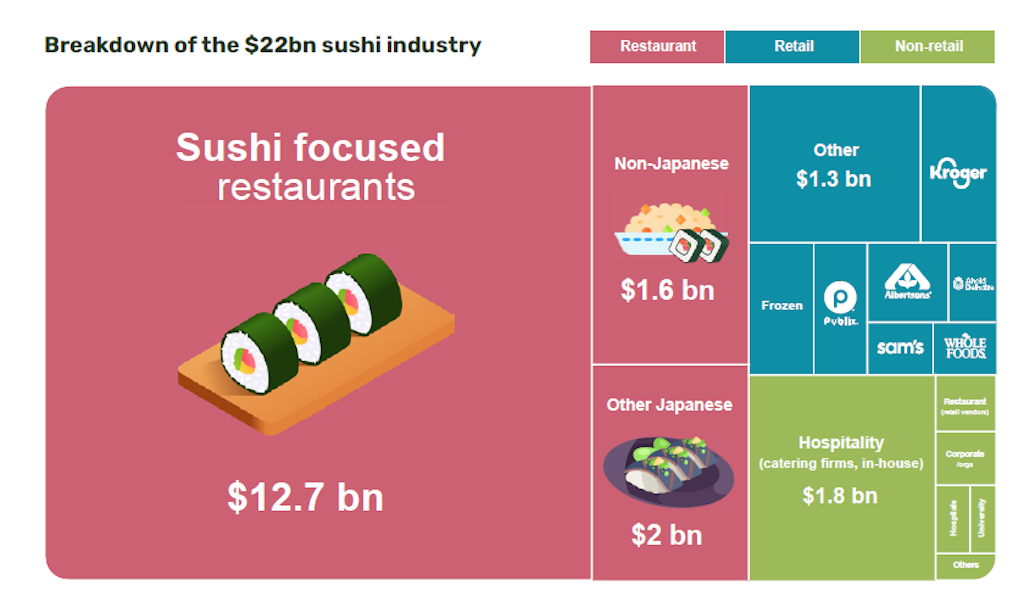
The report, conducted by market research firm Spheric Research, finds that the US sushi industry is now valued at approximately $22 billion, with $16 billion generated through restaurant sales alone, underscoring sushi’s emergence as a major driver of seafood consumption.
Growth is no longer confined to coastal markets. The report highlights that inland states are now among the fastest-growing regions for sushi, driven by increased consumer interest and limited historical availability. Retail expansion has played a critical role with more than 12,500 sushi kiosks across the US, the vast majority located in grocery stores.
Consumer demand continues to rise, particularly among younger demographics. The report shows that Gen Z and millennials are contributing to increased consumption, attracted to sushi’s perceived health benefits, convenience, and global flavor profile. Notably, lower-income Gen Z consumers report higher sushi consumption frequency than higher-income Baby Boomers, signalling a broadening of the category.
‘The council’s landmark report will continue to evolve annually to further appraise the category and to drive increased value to our members,’ said Michael McNicholas, founding chairman of the NFI Sushi Council and CEO of Oddisea SuperFrozen.
‘We welcome additional members from around the world who have an interest in the U.S. sushi market and a commitment to collective impact to join the conversation.’