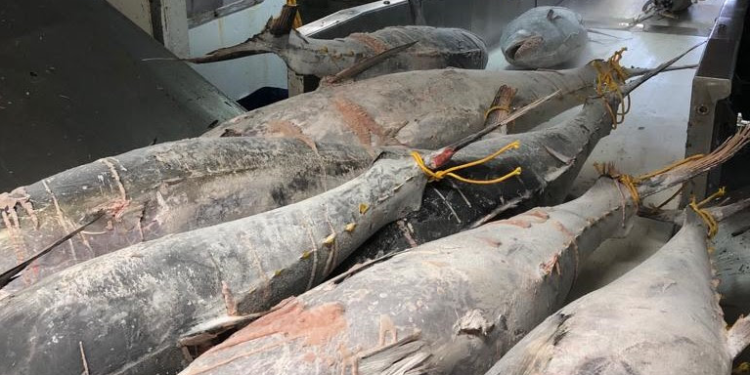





Representatives of the European seafood sector led by Europêche have reiterated deep concerns to DG TRADE and DG MARE related to the proposed free trade agreement between the European Union and Indonesia – the world’s leading tuna producer.
Indonesia currently exports around 200,000 tonnes of tuna annually, and is home to an extremely large and fragmented fleet, estimated at several hundred thousand vessels, with low levels of oversight and transparency. There is no comprehensive fleet register, plus there are quota overruns, at-sea transshipment, lack of scientific observers, and documented risks related to IUU fishing and forced labour – all of which are of serious concern to the highly regulated European tuna sector.
In its current draft, the agreement opens up for Indonesian tuna products, with the elimination of customs duties, particularly on high-value tuna fillets, opening the way for a massive influx of imports onto the European market.
‘This decision is all the more incomprehensible given that the European Commission itself had identified tuna as a sensitive product and had been alerted by the Market Advisory Council,’ an industry representative stated.
‘Under these conditions, it is impossible to guarantee traceability and compliance with sanitary standards of exported products. Orthongel and Europêche are therefore calling on the EU to reconsider its position in order to avoid an economic, social, and sanitary shock for the sector.’
The draft agreement allows for the duty-free import of 800 tonnes of canned tuna and 5000 tonnes of tuna loins, in addition to the full removal of customs duties on tuna fillets (currently 18%) and whole tuna (curently 24%).
While the canned tuna quota is not considered significant, tuna fillets, intended for direct consumption and representing the highest-value segment, are not subject to any volume limitation.
Historically focused on canned products, the European fleet has recently made massive investments to develop onboard freezing technology at -18°C and position itself in the high value-added tuna fillet market. After several years of audits and technical work, the European Commission officially recognised this -18°C freezing method in November 2025, opening new opportunities for the sector.
‘But only a few months later, it is creating an opening for Indonesian products that do not comply with the requirements imposed on European operators, worsening distortions in competition. This situation is inexplicable,’ Europêche states.
‘At a time when tuna is a globalised market, the removal of customs duties for a country showing such glaring shortcomings in sanitary controls and traceability raises legitimate concerns regarding the safety and quality of products offered to European consumers. To our knowledge, Indonesia does not have vessels that are able to freeze at sea at -18ºC.’
The European tuna sector is requesting that the European Commission tintroduce essential safeguards to ensure fair competition conditions, starting with a limitation on volumes by reestablishing duty for tuna fillets or, as a minimum establish a tariff-rate quota (TRQ) on tuna fillets, at the same level as for tuna loins, ie, a maximum of 5000 tonnes.
Also on the wish list are guarantees similar to the MERCOSUR model, with a tuna-specific safeguard clause that can be activated rapidly in the event of increased imports or price disruptions, as well as conditional access to the European market on compliance with standards with a clause allowing suspension of tariff preferences in cases of serious failures regarding forced labour, IUU fishing, or food safety, with mandatory controls and audits. Europêche and Orthongel also want to see strengthened traceability and control requirements, with full transparency of supply chains, extending to vessels, processing facilities, catch certificates, transshipment data.
The European industry also voics its concern that the ILO Working in Fishing Convention (C188), necessary for a level playing field for fishers, is not mentioned in the agreement – while Indonesia is the biggest provider of fishers worldwide.
‘Most of them work on board Asian fleets, where they have terrible working conditions on board, as documented by the ILO and civil society reports’ a Europêche representative stated.