




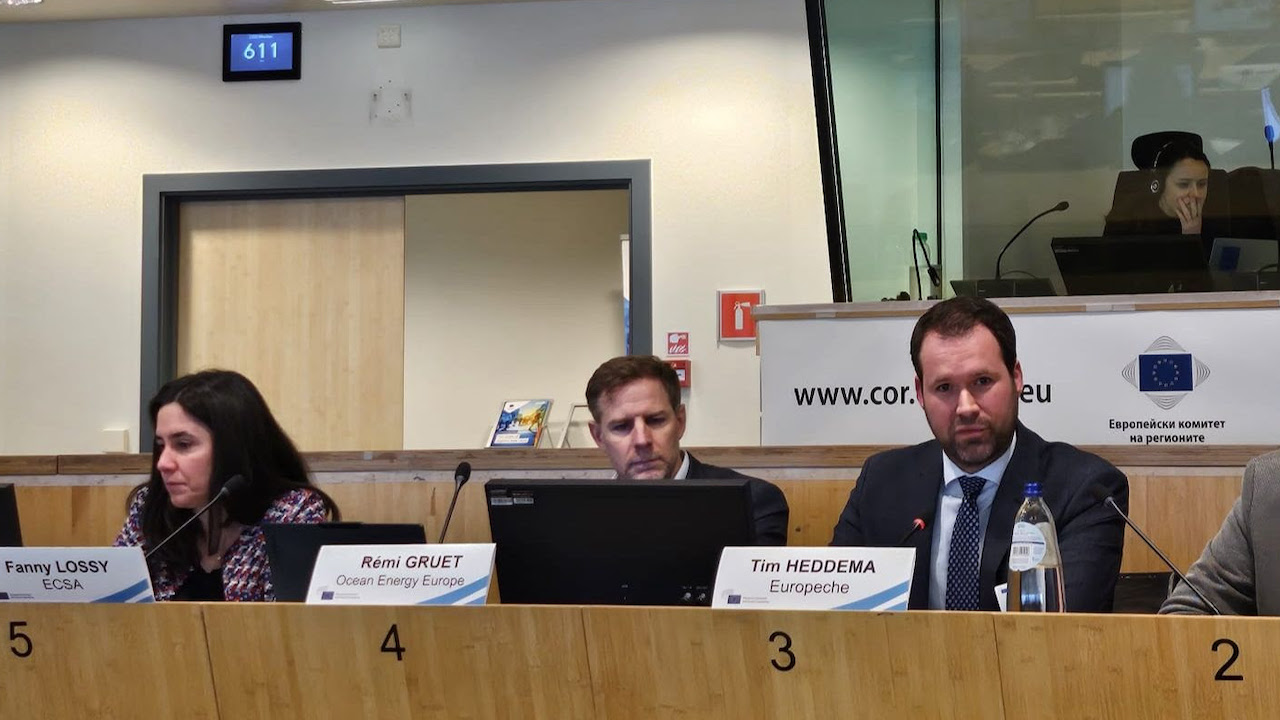
In a public hearing organised by the European Economic and Social Committee (EESC), Europêche Vice-President Tim Heddema stressed the need to keep fisheries at the heart of the EU’s vision for the oceans as the EU Oceans Pact, a political initiative launched by President von der Leyen, is set to be presented at the third UN Ocean Conference in June 2025.
This aims to foster a holistic and integrated approach to ocean-related policies. This includes maintaining a healthy, resilient, and productive ocean, promoting a sustainable and competitive blue economy – including fisheries – and advancing a comprehensive agenda for marine knowledge, research, innovation and investment.
‘EU fisheries are a low-carbon, renewable source of protein, yet Europe imports 70% of its seafood. The Oceans Pact must close this production gap, prioritise EU food production and self-sufficiency, while ensuring that imported seafood meets the same high sustainability standards as EU products,’ he stated.
Tim Heddema called attention to the challenges faced by coastal and fishing communities, compounded by the shocks of Covid-19, Brexit, rising energy costs and increasing regulatory burdens, comenting that such pressures threaten generational renewal and the socio-economic viability of the fleet. To address these issues, he urged the European Oceans Pact to prioritise adaptation policies, streamline bureaucracy, promote social cohesion, and enhance the image of the sector as a modern, attractive and sustainable career.
Maritime spatial planning emerged as a further crucial element in Europêche’s vision for the Pact. The European fishing sector advocated for balanced and inclusive planning to allow a positive coexistence of fisheries with other maritime sectors. Fishers and coastal communities must have a seat at the decision-making table to ensure traditional fishing grounds are protected and that industrial developments, such as offshore wind farms, are implemented without causing undue socio-economic or ecological harm.
Europêche stated that there is a need for a stronger focus on ocean health, emphasising the need for the European Oceans Pact to be grounded in science-based management. Tim Heddema highlighted the fisheries sector as a key contributor to marine data collection, underscoring the importance of strengthening scientific organisations to advance ecosystem-based approaches.
He laid out the need for stronger governance and ocean diplomacy to ensure a level playing field for the European fishing industry. Tim Heddema urged the EU to secure sustainable fishing agreements with third countries, lead global efforts to eliminate harmful fisheries subsidies, and intensify the fight against illegal, unreported, and unregulated (IUU) fishing. He also stressed the need to enhance maritime security, protecting critical infrastructure and trade routes from emerging threats.
‘As the EU shapes its Oceans Pact, it must prioritise this vital sector – one that has sustainably harnessed our seas for centuries, supports coastal communities, and provides healthy, nutritious food to citizens across Europe,’ Tim Heddema stated, and the European sector made it clear that adequate financial support is needed to realise these ambitious goals as the current European Maritime, Fisheries, and Aquaculture Fund (EMFAF) is insufficient to drive the necessary investments in innovation, decarbonisation and competitiveness.
Tim Heddema argued that the recent budget cut of €105 million for 2025–2027 undermines the EU’s commitment to a sustainable future for its oceans and coastal communities.