




This year’s clean-up operation in Norwegian waters has come to an end, again having set a new record for the volume of lost gear retrieved. This year a total of 1687 nets, measuring approximately 46.5km, have been retrieved and removed from the seabed.
This is the third year in a row that the clean-up initiative by the Directorate of Fisheries sets a record.
‘Such a record is both positive and negative. The result shows that the expedition is very effective and is an important contribution to reducing marine litter and ghost fishing. On the other hand, there is reason to ask why annual losses of gear are not reduced with better equipment and stronger materials,’ said expedition leader Gjermund Langedal of the Directorate of Fisheries’ Environment Section.
‘A natural explanation could be increasing trust in the reporting system and the clean-up, increased focus on the environment. The reporting and clean-up system that the Directorate of Fisheries operates under is completely unique.’
Fishing gear worth several million NoK has been returned to owners. The expedition has been conducted over five weeks and covered the coast and the shelf from Ålesund to the Nordkinn peninsula, at depths between 50 and 1300 metres, distributed over 221 stations.
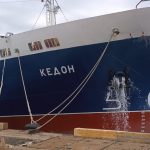
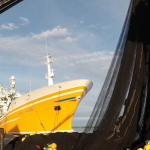
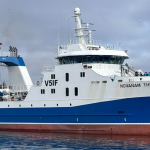
This has been a round-the-clock operation with chartered pelagic vessel Vikingbank.
This year the figures add up to 1687 nets of various types, 34,000 metres of line, 18,500 metres of various ropes, 101 traps as well as weights and anchors, 5200 metres of seine rope, and 3000 metres of discarded wires.
In addition, a seine net from the Greenland halibut fishery and a larger bottom trawl that has been in the water for a long time have been recovered, as well as 6400 metres of trawl warp and approximately 650 square metres of trawl and seine netting.
Significant quantities of fish and various shellfish have been recorded, plus six dead porpoises, six dead seals, one dead whale and one dead walrus. No seabirds have been recorded.
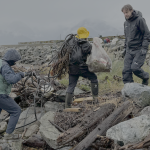
In addition, various clothing, shoes and many different shapes of plastic bags and sacks snagged in nets have been recovered.
Gillnets used in the Greenland halibut fishery are also prominent in the gillnet statistics for 2025. Fishing deep water using smaller boats and with little ability to recover gear in the event of loss, makes this fishing very challenging. In 2024, there were two short fishing periods combined with a high number of participating vessels.
‘This year’s regulation with one long period has been an important contribution to being able to carry out fishing in a slightly more relaxed manner with a reduced risk of losing gear. However, there were probably a good number of fishermen who did not believe that this would contribute to better implementation, so this fishery became intensive and there were some losses at the start,’ Gjermund Langedal said.
‘We believe that a continuation of this regulation will yield good results in 2026 with regard to significantly reduced losses in the Greenland halibut fishery.’
He commented that Norway exports high-value seafood, and the imagery and symbolism of clean seas are very important in the marketing of seafood. Consequently it is important to be able to document that fishing grounds are not littered with fishing gear that contributes to ghost fishing.
‘The unique system for cleaning up lost fishing gear is absolutely crucial in relation to wild fish,’ Gjermund Langedal said.
‘The amount of fish and shellfish that in this way avoids becoming part of ghost fishing indirectly contributes to increased value creation and better management of our stocks that can be harvested for human consumption.’