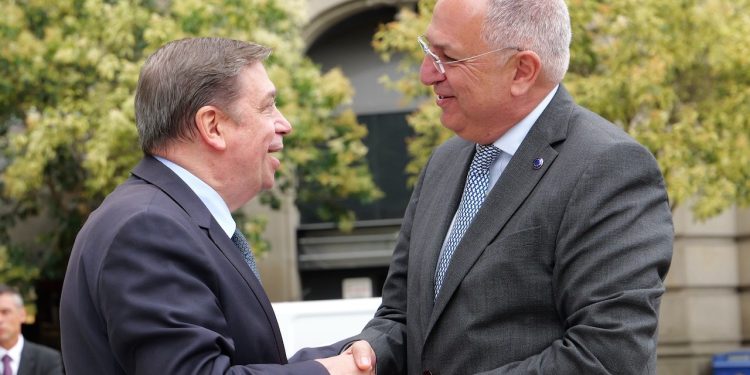





Spain’s Minister of Agriculture, Fisheries, and Food Luis Planas has stated that there’s a need to reform the Common Fisheries Policy ‘to guarantee the sustainability of marine resources and improve the profitability of European fleets,’ with sufficient financial support.
In a meeting in Vigo with Commissioner Costas Kadis, Luis Planas stressed the importance of the future European Maritime, Fisheries and Aquaculture Fund (EMFAF) being flexible, allowing it to address structural challenges and facilitating fleet modernisation and energy transition.

‘We want 21st-century ships and a realistic and viable energy transition for our fleet, with adequate funding and without restrictions that compromise the sector’s competitiveness,’ he said, underscoring that Spain remains committed to science-based decision-making, but noted that sustainability must also consider the social and economic dimensions, in line with the CFP.
In this context, he said that adopting Total Allowable Catches (TACs) and multiannual quotas – which Spain successfully implemented during its last Presidency of the Council of the European Union in the second half of 2023 – would facilitate sector planning, and that quota discussions should be brought forward to the October and November Council meetings.
Luis Planas pointed out that in the Mediterranean, the fishing sector has made significant efforts towards increasing selectivity and implementing catch control measures.
‘We are making an extraordinary effort, and it is essential that, if an improvement in resources is demonstrated, the fishing day limits be reviewed and the sector be rewarded for its commitment to sustainability,’ he said, commenting that the government’s efforts to implement selectivity measures have allowed the Mediterranean fleet to recover fishing days. The ministry has provided aid across the fleet to finance the full cost of replacing 45 and 50 millimetre codends.