


Speaking at the Norwegian Pelagic Federation’s annual meeting, chairman Kristian Sandtorv didn’t hold back on issues facing the industry, ranging from the apparently ever-present threat of oil industry expansion, the wind sector, Norway’s relationship with the European Union and more.
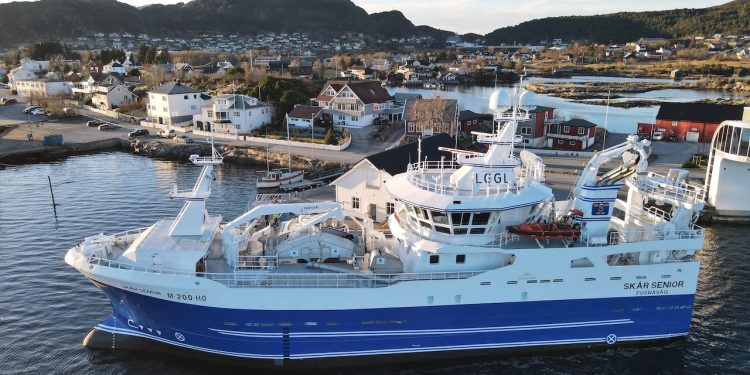
He told the meeting that Norway’s pelagic industry had good results in 2024, with a NoK12 billion result that is a record outcome for the sector.
‘There were good prices for both herring and mackerel, and mackerel was once again the export leader. There has been strong availability of blue whiting in international waters, and at the same time the prices of raw materials for meal and oil have been good,’ he said.
‘At the same time, there are negative population trends for sandeel and Norway pout that we must take very seriously. We must do the same when it comes to the low abundance of capelin.’

He questioned the directions taken by the Institute of Marine Research, not least as the industry faces numerous challenges and with so much happening at sea.
‘There’s increased industrial activity with offshore wind, carbon storage, offshore aquaculture, cod farming, and extraction of seabed minerals to name a few. At the same time, there is a decline in several fish stocks. I am concerned that budget cuts for the Institute of Marine Research could have serious consequences for the future of fishermen,’ he said, voicing concerns that fewer surveys and less research provide less knowledge about the ocean at a time when knowledge is more necessary than ever.
‘Inadequate data can lead to greater uncertainty in stock estimates, which in turn leads to greater safety margins in quota decisions,’ he said, pointing out that there are declines in cod and mackerel stocks, and there is concern that the North Sea herring stock is even lower than the Institute’s estimates. At the same time, snow crab research has been discontinued, blue whiting research has been cut back, while there is a zero-quota advice for Barents Sea capelin and spawning surveys next winter are not a priority – plus there is zero-quota advice for sandeel and Norway pout.
‘How can the director claim that we have full control, when this is what we see? I believe we would have a much stronger institute, with more accurate research, if researchers and fishermen collaborated much more closely than we do today,’ Kristian Sandtorv said.
‘New debates that affect fisheries are constantly emerging. Among other things, an impact assessment of the sea areas off Lofoten, Vesterålen and Senja (LoVeSe) for oil and gas is on the agenda,’ he said, and asked whether fisheries should give way to providing a stable energy source for Europe in turbulent times?
‘That’s clearly what the Conservative Party and the Liberal Party think. Our view is the same as before. We are very sceptical that this will now come up again now that we have the knowledge we have,’ he said and commented that alongside this, unrest on a global scale has yet again re-ignited the EU debate in Norway.
‘Donald Trump’s trade policy has caused concern for both the Norwegian authorities and the seafood industry. The USA has become increasingly important to the seafood industry. But if we are excluded or high tariffs are imposed, we will become even more dependent on the EU. Could the Norwegian seafood industry’s need for security and stability lead the industry to conclude the opposite outcome of 1972 and 1994?’ Kristian Sandtorv asked.
‘Would more people rather vote yes this time?’