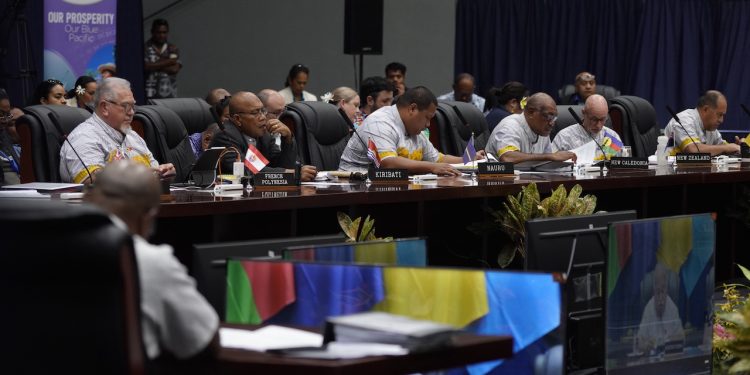





Pacific Islands Forum Fisheries Agency (FFA) D-G Noan David Pakop addressed Pacific leaders at the 54th Pacific Islands Forum Leaders Meeting (PIFLM54) in Honiara to outlining the region’s achievements in fisheries cooperation and development, while calling for continued vigilance against ongoing challenges.
Speaking at the Leaders Dialogue with CROP heads, he delivered a presentations during the session on Political Leadership & Regionalism and Peace & Security to highlight the strategic importance of fisheries and the collective role of Monitoring, Control and Surveillance (MCS) in safeguarding the Pacific’s tuna resources.
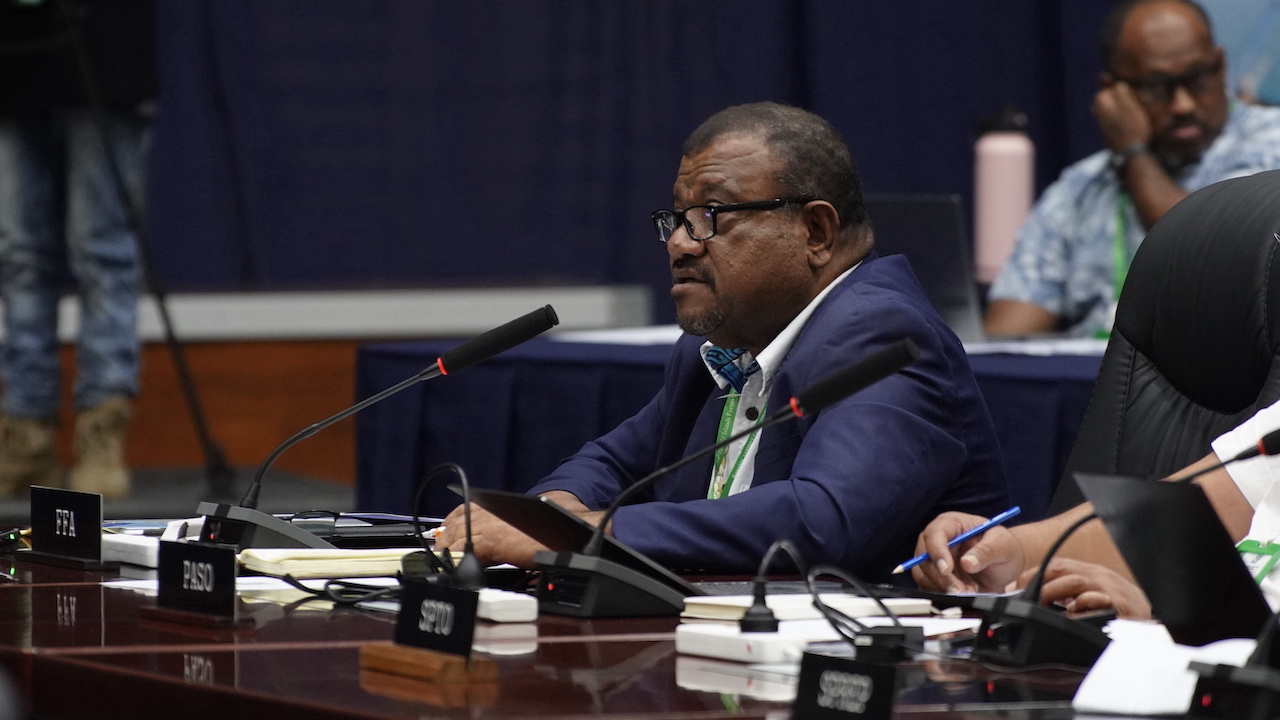
‘Our Blue Pacific Continent spans over 30 million square kilometres and over 20% of the world’s EEZs. Within it, tuna is our region’s common currency – sustaining government revenues, livelihoods, food security, and employment. These benefits are only secure when we work together, upholding maritime sovereignty and exercising vigilance against illegal, unreported and unregulated fishing,’ he stated, pointing out that the Pacific remains the only region in the world where all four major tuna stocks – skipjack, yellowfin, bigeye, and albacore – are biologically healthy. He pointed to strong results in tackling IUU fishing, with losses reduced from US$152 million in 2016 to US$43 million in 2021.
In his People Centred Development and Resource and Economic Development presentation, Noan David Pakop reported that Member fleets now capture 61% of the catch value within Pacific waters, compared with 38% a decade ago. Regional tuna processing has nearly doubled since 2015, reaching 286,000 tonnes.
More than 26,000 Pacific Islanders are employed in the region’s tuna industries, a 19% increase since 2015, while government revenues from licensing and access fees remain strong at around US$500 million annually – funding vital services such as education and health.
While celebrating progress, Mr Pakop also reminded Leaders of the pressing challenges facing the region, including climate change, shifting tuna distribution, economic pressures, and continuing IUU fishing activities.
He urged Leaders to extend MCS frameworks to the high seas, strengthen investment in technology and data sharing, as well as coordinated enforcement – and integrate fisheries surveillance into broader regional security frameworks.
‘By resourcing our joint surveillance and staying united, we will ensure that our Blue Pacific fisheries continue to underpin resilience, security, and sustainable development for generations to come,’ he said.
‘The progress we have made tells us one thing – working together makes us stronger. As we look to the future, the FFA remains committed to ensuring our tuna legacy benefits Pacific people first and foremost. Let us continue to work together, innovate together, and lead the world in sustainable fisheries management – for our people, our ocean, and our future.’