



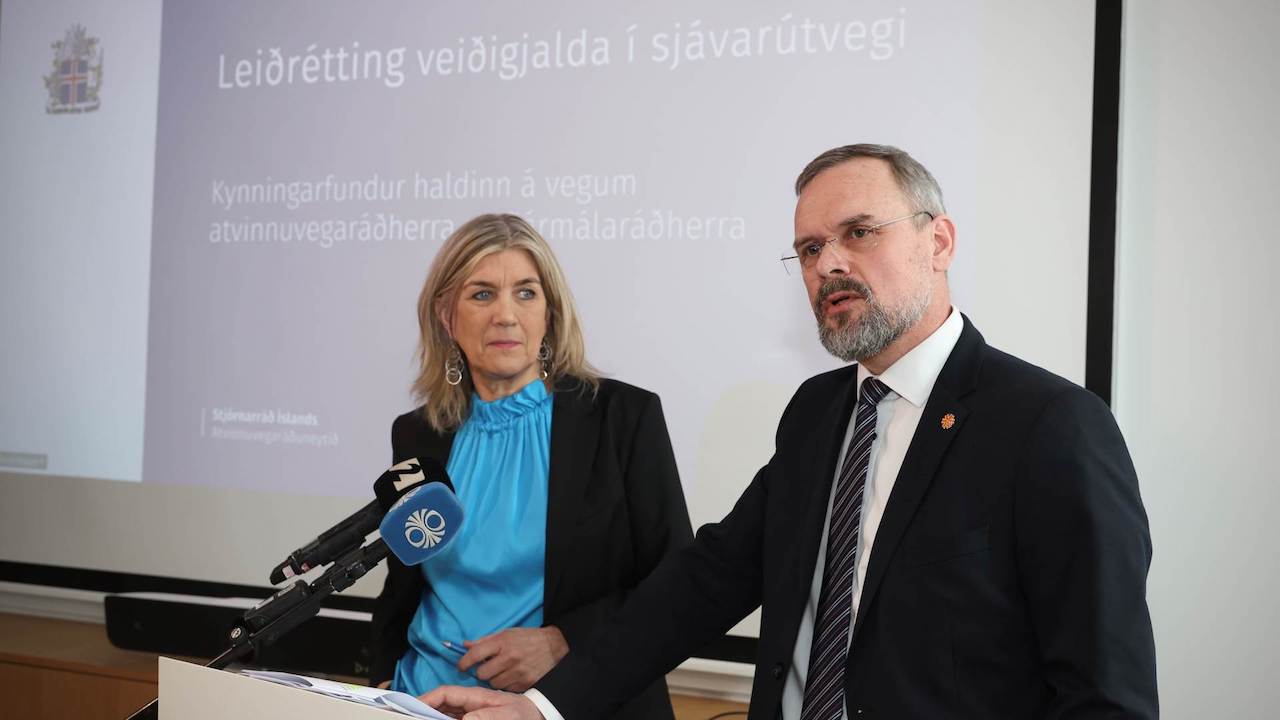
Iceland’s Minister of Industries Hanna Katrín Friðriksson and Finance Minister Daði Már Kristófersson have outlined changes to the fisheries levy that would place a greater financial burden on the industry, while increasing government revenue.
Depending on which side of the industry you listen to, it’s a move that’s either long overdue and which fails to go far enough – or it’s a death knell for the industry. Addressing the thorny issue of a realistic resource levy benefitting society as a whole was a key policy aim of the new government when it took power at the end of last year.
According to the Ministry of Industry, which has responsibility for fisheries, examination of the resourse levy indicated that the catch value of commercial stocks had been significantly underestimated, and the aim is for this to be corrected.
‘This is not a change to the fisheries management system that has been in use over past decades, but a necessary adjustment,’ the Ministry states, pointing out that the study demonstrated that a large proportion of catches is traded between fishing operations and linked processors, meaning that no realistic trade takes place in these instances.
‘The pricing in such business has not been in accordance with market prices,’ the Ministry states.
The inention is to change the resource levy in such a way that the values of cod and haddock at domestic auctions is to be used as a benchmark, while for herring, blue whiting and mackerel, market prices in Norway is used as a benchmark. Operators will get to keep 67% of profits, while 33% of profits will accrue to the state.
It comes as no surprise that vessel operators’ federation SFS has been quick to criticise a policy that hits its members in the pocket, accusing the government of seeking to inflate their revenues from fishing by using auction prices as benchmarks.
SFS states that the Icelandic seafood industry’s record of value creation and competitiveness is based around a vertically integrated value chain, and that this has brought higher values to Iceland than are returned in any other country.
‘This success is what the government aims to rip up,’ and SFS representative commented, predicting a gloomy future as greater volumes of fish will henceforth be shipped overseas to be processed in low-wage economies,’ SFS’s representative said, predicting tough times to come.
The government’s calculations estimate recalibrating the resource levy will put an addition ISK 10 billion into government coffers, with the lower threshold lifted for smaller and medium-sized operators.
‘Correcting the resource levy is this government’s policy to meet the demands of the electorate for fishing operators to pay a reasonable levy for the use of a national resource. This is is intended to ensure the nation a direct and visible benefit from the proceeds of fishing, and for this to be used for urgent projects, such as road infrastructure around the whole country,’ Minister Hanna Katrín Friðriksson said.