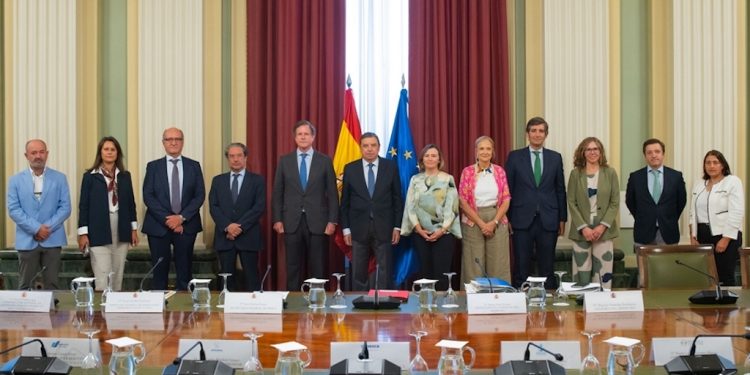





The Spanish fishing industry represented by Cepesca has called on Minister of Agriculture, Fisheries and Food Luis Planas to firmly advocate at the European Council for a specific fund for fisheries under the Multiannual Financial Framework 2028-2034. Current proposals are for an allocation for fisheries limited to €2 billion compared to the €6.1 billion under the current European Maritime Fund for Fisheries and Aquaculture (EMFFA), in force until 2027.
The industry states that this represents a 67% cut at a time when the overall EU budget is also increasing.
Organisations attending the meeting agreed to establish a united front to defend this demand.
Cepesca has warned Luis Planas that, under the European Commission’s legislative proposal, which establishes a single budget for agriculture and fisheries in its Article 10, no amount is specified for the sector, and this deamnds a formal specification. According to the fishing sector, merging budgets with others risks relegating fisheries to a marginal role, without its own financial instrument.
In the industry’s view, this contradicts the EU’s strategic priorities, which set out the need to strengthen the Union’s competitiveness and strategic autonomy. The fishing sector wants to see the future budgetary framework establish mandatory minimum allocations for fishing, so that resources are not diluted in competition with other sectors, and that it guarantee harmonised co-financing that allows for the modernisation, sustainability, and safety of the fleet to be addressed, on equal terms among Member States.
During the meeting, the industry stressed the importance of Spain co-ordinating its position with other countries with a long fishing tradition, such as France, Portugal, Italy, and Ireland , in order to establish a common front that guarantees fair treatment for a sector essential to food security, coastal employment, and Europe’s strategic autonomy.
The fishing groups state that fisheries is one of the few truly common EU policies and that a Common Fisheries Policy is inconceivable without a specific fund, ‘as it could open the door to the dilution of resources.’
Alongside this risk is the potential mandatory alignment with the European Ocean Pact, which would direct part of the resources toward blue economy sectors other than fisheries, such as marine energy, biotechnology, and desalination.
Cepesca warns that without mandatory co-financing mechanisms for vessels over 12 metres, support measures would be left to individual Member States, potentially creating unfair competition within the EU itself.