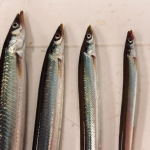






Advice from Norway’s Institute of Marine Research is a continued zero quota for the Barents Sea capelin fishery in 2026. A definitive decision will be taken this week by the Norwegian-Russian Fisheries Commission.
‘This year’s measurements show that there were small quantities of capelin in the Barents Sea and especially in the normally most important feeding areas on and around Storbanken,’ said Georg Skaret.
‘After two strong year classes in 2019 and 2020, recruitment has been weak, and calculations show that the spawning population is now the lowest measured since 1995.’
The recommendation is for a zero quota in 2026, as it was this year, not least as the stock level is estimated to be 40% kower than last year.
‘The capelin population is a long way down, but history has shown that it has a strong tendency to come back if given time to rebuild,’ Georg Skaret said, commenting that the Institute’s ecosystem survey in the Barents Sea is a key source of understanding of the capelin population – with very good coverage this year.
‘We covered the entire area where capelin is normally distributed at this time, on both Norwegian and Russian sides,’ he said.
Capelin in the Barents Sea is a short-lived species, and fish die soon after spawning. Capelin rarely live more than five years. As a result, the capelin population can vary significantly in quantity, distribution and growth from year to year. Since 1972 when assessments began, researchers have observed three clear collapse periods where the population has remained at a very low level for at least four years.
The last decade has been characterised by more short-term fluctuations, where low years with zero catches such as 2016 and 2019 have alternated with years where the stock level has been higher and there has been an opportunity for fishing.
‘The stock is now again below harvestable levels, and the relatively low quantities of immature capelin indicate that there are not many chances for a fishery in 2027 either,’ Georg Skaret said.