




Norwegian fishing vessel operators’ federation Fiskebåt is applying pressure for the Institute of Marine Research to reassess the need for a separate snow crab expedition in 2025, amid concern that leaving this out could have negative implications for the fishery.
‘The Institute of Marine Research has conducted its annual snow crab surveys in the Barents Sea since 2018. The surveys have been important for mapping the population density and distribution of snow crab on the Norwegian continental shelf,’ said Tor Are Vaskinn at Fiskebåt, commenting that there is a relatively short history of these surveys, going back just six years, plus this is a new fishery.
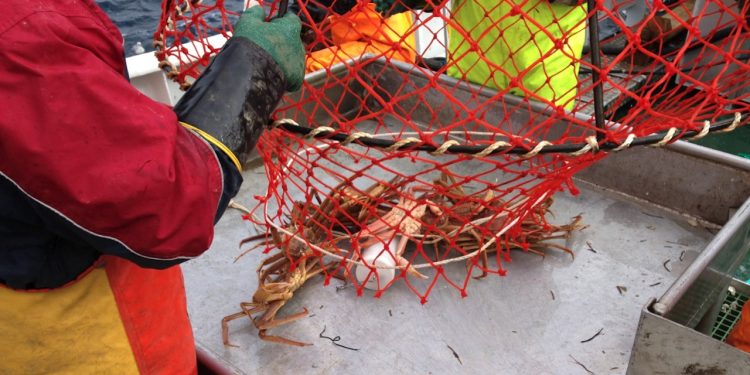
The first catch by a Norwegian vessel was landed in 2012, and since then the fishery has developed gradually. This year’s fishing could yield a first-hand value of over 1.5 billion kroner, making it one of the country’s largest demersal fisheries in value terms. The Institute’s Research Director Geir Huse confirmed that no snow crab survet would be carried out in 2025. Instead, population level estimates will be based on historical data and catch data from the snow crab fleet.
Fiskebåt sees is as crucial that the Institute of Marine Research is aware of the changing fishing rate and size composition of delivered snow crab in 2025.
‘As a direct consequence of such regulation, we are moving from an Olympic fishery to one in which price per kilo is given more emphasis than in previous years. This may lead to a decrease in the general fishing rate in the fleet, as smaller crabs of legal size are returned for later harvest,’ Tor Are Vaskinn said.
He stated that Fiskebåt has concerns that a change in the methodology from cruise-based to a comparison of Catch per Unit Effort (CPUE) could lead to misleading and incorrect conclusions with regard to stock estimates. This could lead to incorrect quota determination in the years to come.
Fiskebåt’s position is that it wants the survey to be carried out this year and in the years ahead. ‘If, despite our demand for a continuation, no survey is carried out in 2025, we believe it is crucial that the Institute of Marine Research takes into account size distribution and distribution when assessing the snow crab population, and that the Institute has an active approach to the changed fishing practice in 2025 compared to previous years,’ he said.
‘In addition, there are vessels that have not previously engaged in snow crab fishing that have been granted permission to fish snow crab. The change in participation may also affect the catch rate.’