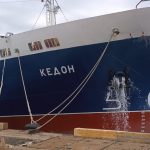






Recurring breakdowns of South Africa’s fisheries research vessel Africana threatens the 40-year data record that underpins the trawl fishery for hake and its long-standing MSC certification , according to SADSTIA executive secretary Johann Augustyn.
He commented that since 1986 South Africa’s summer and an autumn survey of hake stocks have run like clockwork.
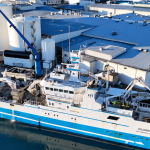
‘That is no longer the case,’ he said, adding that research vessel Africana is old, and over the past decade at least four or five demersal surveys have been postponed or missed entirely because of vessel breakdowns.
‘Since the start of 2025 alone, three surveys have been missed as a direct result of the vessel’s condition. Government and industry are engaging constructively on the problem, but the downward trend raises two questions: just how important are these surveys, and what is the solution?’ he said.
‘The answer to the first question is straightforward: the surveys are exceedingly important. Forty years of consistent, methodologically comparable trawling, conducted in the same areas at the same time of year, have built a solid, reliable time series. That time series forms one of two pillars supporting the hake operational management procedure (OMP) – the mechanism used to set an annual total allowable catch (TAC). The other pillar is the fishing industry’s own catch data, which generates a catch-per-unit-effort measurement. Importantly, the two datasets verify one another: survey data provides a fishery-independent measure of abundance, while commercial catch rates reflect what the fleet is actually experiencing in the fishing grounds. Together they provide a far more robust basis for stock assessment than either could do alone.’
The methodology has satisfied the MSC, which closely scrutinises the science behind the trawl fishery’s management and has certified it as sustainable and well-managed since 2004. Losing that certification risks job losses and a substantial contribution to GDP.
‘Since 2004, MSC certification has been renewed every five years on the strength of continuous, credible science. If one pillar of the OMP is weakened, the case for “sustainable and well-managed” becomes harder to make – not just to MSC auditors, but as a matter of fact, because the fishery would genuinely know less about its own resources than it does today,’ he said.
One solution would be to replace Africana with a new, purpose-built vessel, at an estimated cost of at least R1 billion. A second option, used before, is for government to charter industry-owned vessels for stock assessment.
‘This is workable in principle, but costly for government and disruptive for vessel owners who risk falling short of their own quotas while their vessels do government’s work. A third, potentially more sustainable option is a public–private partnership established specifically to operate a research vessel on behalf of both government and industry. Such a model would need to be carefully structured to ensure that costs and responsibilities are shared appropriately, recognising that fisheries research and stock assessment are ultimately public functions that serve national economic objectives,’ he said, pointing out that the South African fishing industry and government have a strong history of working together on difficult problems, and the future of South Africa’s fisheries research capability should be treated as one of the most important.
‘What this moment requires above all is clarity about the stakes. The demersal survey programme is not simply an investment in good science, it is a strategic national asset. Four decades of largely uninterrupted data underpin sustainable resource management, support MSC certification, safeguard access to premium export markets, and help protect thousands of jobs throughout the fishing value chain. Whether the solution is a replacement vessel, charter arrangements or an innovative public–private partnership, action will almost certainly cost far less than allowing the survey programme to fail,’ Johann Augustyn said.
‘The real question is not whether South Africa can afford to invest in fisheries research capacity, but whether it can afford not to.’