





Frontline agencies from the Pacific Quadrilateral Defence Coordination Group (PQUAD) – Australia, New Zealand, France and the United States of America – partnered with colleagues from Tonga, Fiji, Vanuatu, the Solomon Islands and the Pacific Islands Forum Fishing Agency to conduct Operation Nasse this year.
Now in its tenth year, this multilateral operation provides enhanced maritime surveillance of international waters. It aims to detect and deter IUU fishing and promote compliance with international conservation and management measures agreed through the Western and Central Pacific Fisheries Management Commission (WCPFC).

The joint approach helps ensure long-term sustainability of international tuna fisheries by encouraging accurate reporting and practices that minimise environmental harm, while also enabling assessments of key international stocks, such as the South Pacific Albacore.
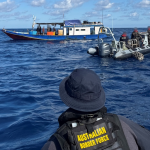
The United States Coast Guard Oceania District hosted this year’s joint coordination centre in Honolulu, Hawaii, directing aerial and sea assets in targeted areas of operation, including US Coast Guard Cutter Harriet Lane (WMEC 903), New South Wales Police Force Offshore Patrol Vessel Nemesis, French Navy vessels Auguste Benebig and Teriieroo a Teriierooiterai, Gardian aircraft from the French Armed Forces in New Caledonia, a P8-A from the Royal New Zealand Air Force and a King Air aircraft from the Pacific Islands Forum Fishing Agency.
‘This multinational operation is integral to combat illegal, unreported, and unregulated fishing in the Pacific Ocean,’ said US Coast Guard Lt. Cmdr. Mary Kate Wheeler, joint coordination centre commander for Operation Nasse.
‘Protecting marine resources, ensuring sustainable fisheries, and safeguarding the livelihood of Pacific Island nations all contribute to stability within the region. We are grateful to our Pacific partners for their invaluable contributions and close coordination through every step of this mission.’
Together they covered over 6.54 million square nautical miles, made 80 aerial sightings of fishing vessels and conducted 31 boardings and inspections on the high seas. Potential violations of WCPFC conservation and management measures were identified and referred to the relevant flag state for investigation in accordance with WCPFC procedures.
‘Our partnerships with Pacific nations, the Forum Fisheries Agency and the PQUAD group enables the type of collaboration necessary to protect shared fisheries and the marine environment,’ said Justin Bathurst, AFMA’s general manager of fisheries operations.
‘I’d like to thank our friends from Tonga, Fiji, Vanuatu and the Solomon Islands for supporting Operation Nasse in its tenth year, and I hope to see these partnerships continue to grow stronger in the future. Working together is the best way to protect Pacific fish stocks and stand against illegal fishing, especially where it occurs on the high seas.’