




Updated catch advice from the Marine and Freshwater Research Institute (MFRI) in Iceland and the Greenland Institute of Natural Resources (GINR) for the upcoming capelin fishing season is just over 105,000 tonnes. This is an initial recommendation which will be superseded by fresh advice following further acoustic surveys in the new year.
The advice is based on the results of acoustic surveys on the capelin stock conducted in September, which proved to be significantly below expectations. Due to adverse conditions in the northernmost survey area, full coverage of the stock’s distribution area was not achieved, meaning the stock size is likely underestimated.
Research vessels Tarajoq and Árni Friðriksson carried out capelin surveys between 23rd August and 26th September off eastern Greenland and northern Iceland. Although the plan was successfully executed across most of the research area with coverage deemed satisfactory, the northernmost coverage was incomplete due to frequent storms. As a result, a coarser grid had to be surveyed in the northern area to obtain measurements between storms, and sea ice ultimately prevented further survey work. In the southern part of the area, the capelin found was almost exclusively juvenile, while adult capelin was located further north – extending all the way to 71°N, where conditions forced Árni Friðriksson to turn back.
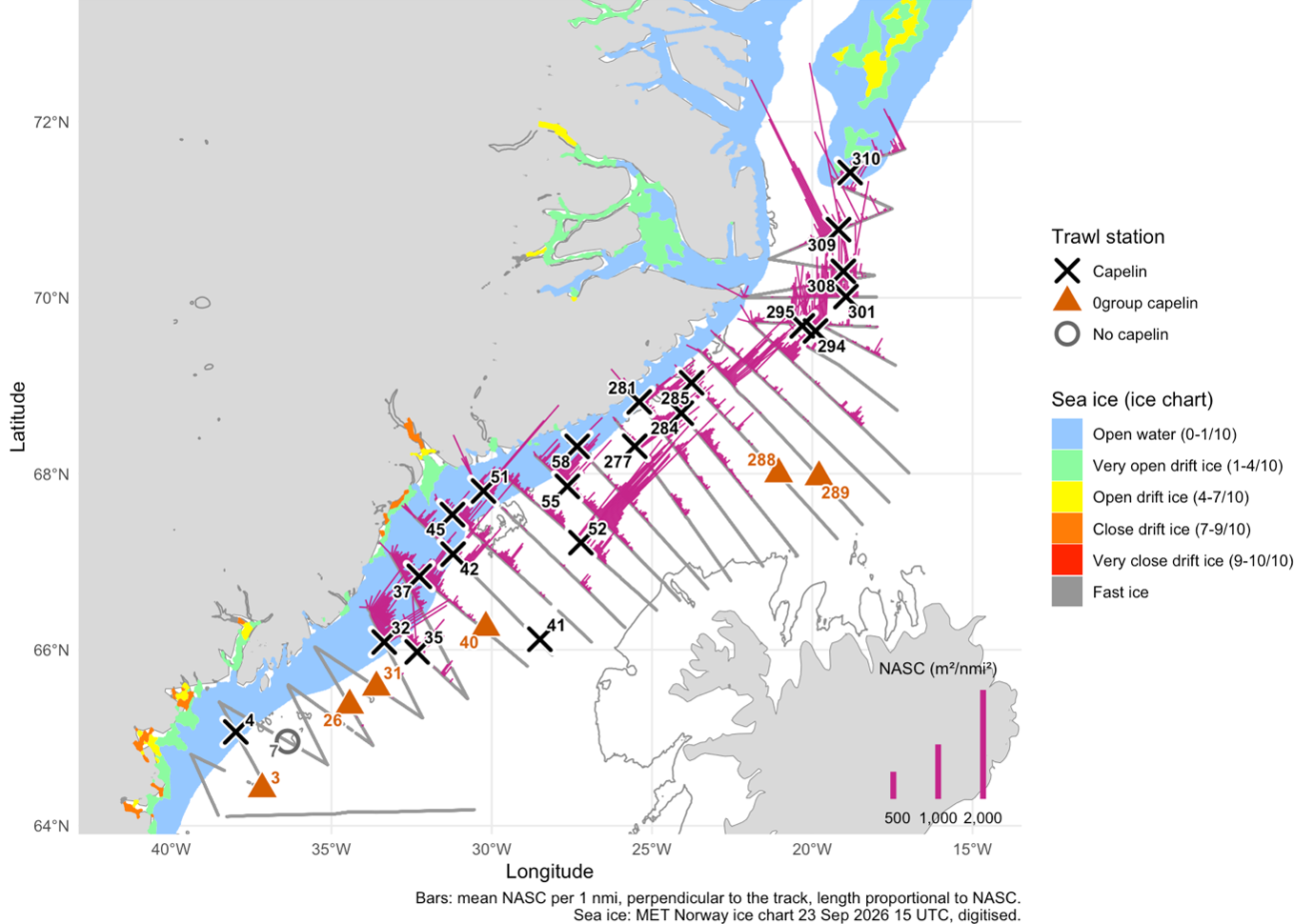
Taking into account the agreed harvest control rule and estimated predation, measurements support a catch recommendation of 105,773 tonnes. It should be noted that the harvest control rule states advice based on autumn stock measurements should be set at 2/3 of the calculated total allowable catch, which was 158,660 tonnes and indicates how this measurement affects the catch.
The measurement of the fishable stock size is well below expectations based on juvenile capelin measurement from autumn 2025. The initial advice based on that measurement was 358,044 tonnes, which the new advice now replaces. The discrepancy between these two survey results is believed to stem from, at least in part, an underestimation of the fishable stock size due to the incomplete survey coverage in autumn 2026.
Measurements of juvenile (immature) capelin abundance came in at 65.9 billion individuals, meaning initial advice for the 2027/28 fishing year will likely be 83,283 tonnes according to the harvest control rule in place.
Final advice for the current season, which will replace the advice of 105 thousand tonnes, will be issued following winter acoustic surveys in the new year. Final decisions regarding the arrangements for those surveys have not yet been made, but the results of this latest survey will influence them.
A TAC of 105,000 tonnes would be divided according to agreements with neighbouring nations. The Icelandic fleet would get 85,676 tonnes. Greenland would have 19,039 tonnes and 1058 tonnes would go to Norway, subject to Norway becoming part of the capelin agreement before January.
Otherwise the Norwegian share is divided between Greenland and Iceland. The bilateral agreement between Iceland and the Faroe Islands expired some months ago, so as things stand, the Faroese fleet has no access to the capelin fishery around Iceland.