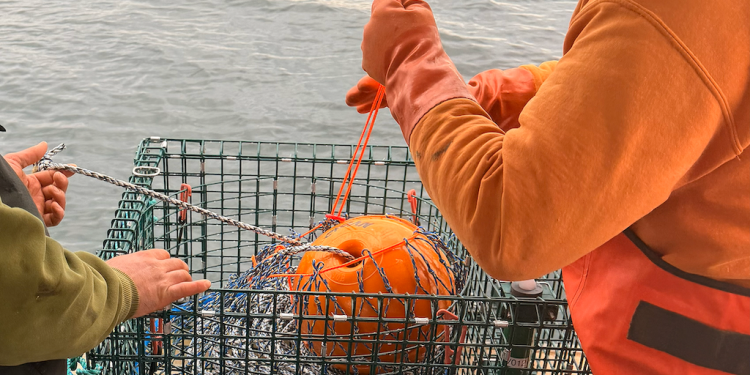




NOAA is warning seafarers to watch for specially flagged vessels off Massachusetts and Rhode Island as the Northeast Fisheries Science Center Gear Research Team collaborates with commercial lobster vessels to test on-demand (ropeless) fishing gear for lobster and Jonah crab.
The experimental fishery began on 1st February and continues until 30th April in state waters north of Cape Cod, and could extend until to 15th May. Similar trials were conducted 2023, 2024, and 2025.
The fixed gear involved in this research is not visible at the surface as no surface buoys are used.

‘Our gear team and participating fishermen are particularly concerned about gear conflict this winter and spring in the testing area immediately west of the Nantucket Lightship and north of the shipping channel,’ a NOAA representative said.
‘On-demand gear in that area is set along depth contours (approximately east-west), close to the loran 0s and 5s, and can be up to 1.75 nautical miles in length. On-demand research gear will be moved ahead of the Northern Gulf of Maine Scallop Management Area opening on 1st April to avoid areas of typical scalloping activity. On-Demand research is prohibited in Cape Cod Bay and Nantucket Sound.’
The testing seasons within the restricted areas are 1st February to 30th April in the South Island Restricted Area and 1st February to 30th April in the Massachusetts Restricted Area , which could extent to 15th May.
Research gear will not be surface marked, but will be marked digitally and can be viewed using the free EarthRanger Buoy app or select chartplotters. TimeZero users can view gear positions by turning on the experimental feature in version 5. Olex users can purchase an update to add this functionality. Stable internet is needed to view nearby gear positions in real-time. Those without internet at sea can use the EarthRanger Buoy app to download gear positions before leaving the dock. Stored positions will display when within a 5-mile radius, but will not reflect changes made after the download.
‘Our short-term goal is to work with industry partners to support deployment of on-demand systems in circumstances that minimise the potential for gear conflict while allowing fishing to continue,’ NOAA’s representative commented.
‘Ultimately, for on-demand fishing gear to meet conservation goals for marine mammals and to support fishing on a large scale, it must move beyond an experimental stage. We are committed to working with fishery management authorities to consider the regulatory changes needed to allow fishermen to use on-demand fishing gear if they want to.’