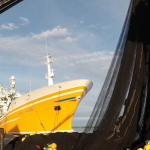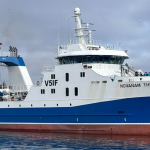
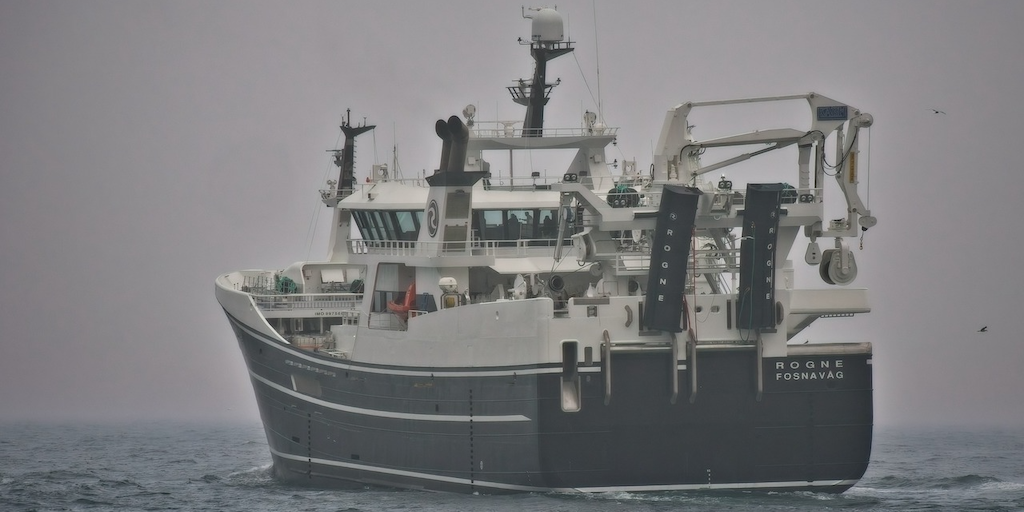
New pelagic vessel Rogne has docked at Leinevik in Herøy for the first time, following the delivery trip from the Karstensen yard. This is the latest in a long series of pelagic vessels completed at the yard in Skagen.
The 83-metre by 16-metre breadth Rogne replaces an older vessel of the same name, which was built at the same yard in 2013. It is expected to operate as a pelagic trawler on blue whiting and to fish with purse seine gear for herring and mackerel.
This is the fourth Rogne since the company was established in 1965 by Bjarte Rogne, later joined as co-owner by his brother Marvin. Today the company is run by Frank, Kjell-Ove and Per-Magne Rogne, all of whom are active in the wheelhouse.
Designed by the Karstensen yard with the owners’ input to tailor the newbuild to their operating pattern, Rogne has an almost vertical bow with a waterline bulb. RSW capacity is in 13 tanks.
Rogne is outfitted with a pair of main engines. These 3600kW Bergen Diesels power a 720/115rpm reduction gearbox to drive a 4500mm diamater propeller, both delivered by Brunvoll Volda. Together they provide the power needed for pelagic trawling, and all the energy needed for the electrical system and the side sthrusters while purse seining, while just one engine is enough for steaming.
The main engines also each run a Cummins 2320kW shaft generator, plus Rogne has a pair of Nogva Scania DI 16 auxiliary engines. The electrical system is designed to offer the option of parallel operation of the two generators. The electrical system comes with a Power Management System to oversee power consumption and automatic start-up of the diesel generators.
UPS/clean power for 230V is installed, so that the ship’s frequency can flow between 50 and 60 Hz. This makes it possible to reduce the speed of the main engines by 17%.
The high lift flap rudder is from Kongsberg and the steering gear is a Kongsberg Tenfjord SR 722 system.
Rogne also has a Brunvoll azimuth AR80-LTC2100 thruster and a Brunvoll FU74-LTC2000 side thruster.
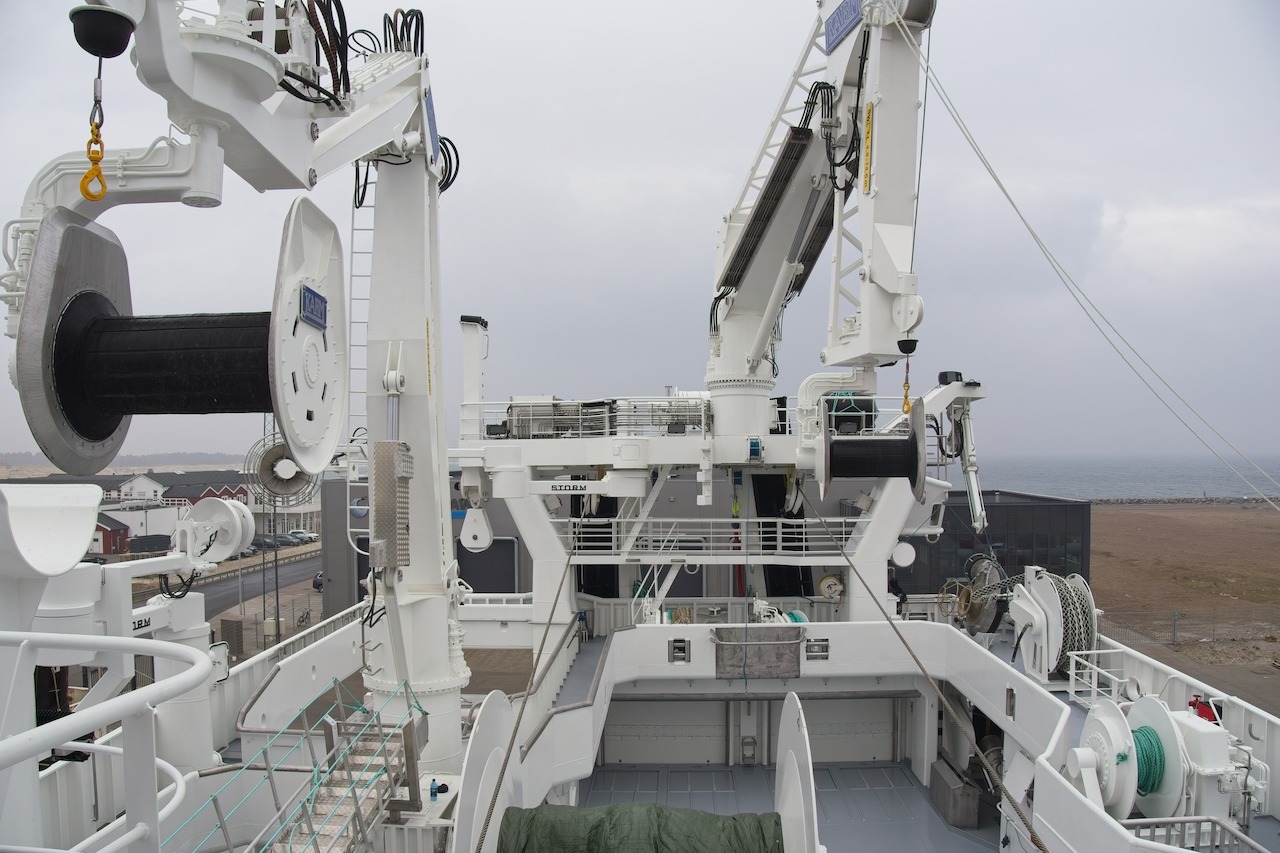
Rogne’s owners went to Karmøy Winch for the deck equipment package for both trawl and purse seine fishing. The 90-tonne main trawl winches are managed by a Karm autotrawl system. Net drums are a pair of 148-tonne pull units plus a 110-tonne unit, aligned to the stern gates and hydraulic control rods, and the Karmøy package includes tail-end, net sounder and a variety of auxiliary winches. The purse seine setup has a pair of 40-tonne purse winches and a 40-tonne Tristar Giant net hauler. Karmøy Winch supplied an array of handling equipment and cranes from Storm Cranes, including corkline and leadline stackers, net and fish pump cranes, as well as a comprehensive package of drives for the winches, cranes and fish pumps.
Rogne has a pair of 20-inch Karm fish pumps, with hose reels supplied by SeaQuest. Catches are routed to the selected RSW tanks via a built-in dewatering box. The RSW system is a triple 1100kW PTG FrioNordica installation, and C-Flow supplied the vacuum system.
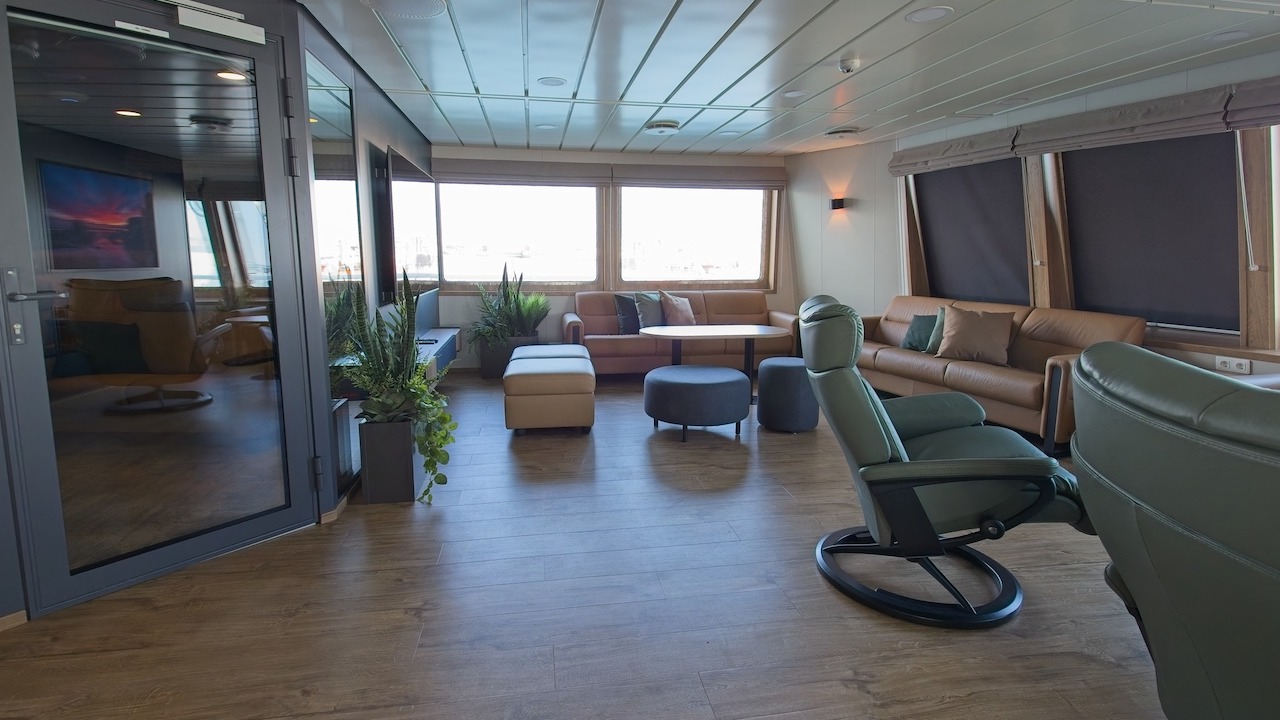
The placement of Rogne’s accommodation and crew areas as far as possible from the propeller, plus innovative noise insulation measures, and other noise sources has resulted in a quite, comfortable vessel. Accommodation is in ten en-suite cabins on the second deck and four cabins in the superstructure, along with the galley, mess, lounges, gym and laundray facilities.
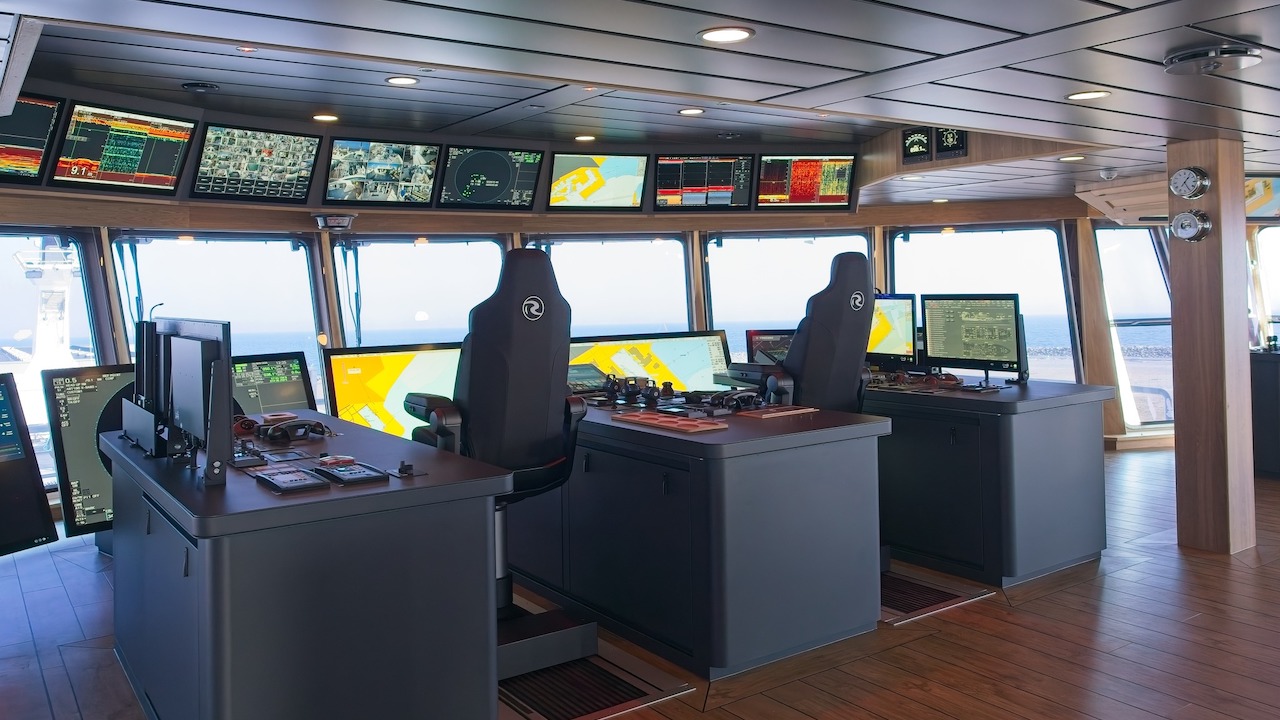
The wheelhouse with 360° visibility as a pair of control points facing the Furuno BlueBridge matrix of screens, plus an aft wheelhouse control position oervlooking the deck is flanked with all the necessary repeater screens.
The main fishfinders are the Furuno FSV-25 and Simrad ST94 low-frequency sonars, plus the medium-frequency set and a Kaijo Denki high-frequency sonar, in addition to the pair of Furuno Imagenex TS-360 trawl sonars. The echo sounders are Furuno FSS-3B and Simrad ES80 sets. The current log is Furuno CI-68
Rogne’s navigation systems include a selection of plotters, with twin Tecdis T-2138A units, plus a pair of MaxSea Time Zero sets and an Olex. Radars and the GPR gyro are Furuno systems and the gyro compass and autopilots are from Simrad. Comms are handled through the Sailor radio systems and Starlink satellite capability, in addition to the Thrane Iridium satellite phones. The thermal camera is a gyro stabilised Flir M625CS.