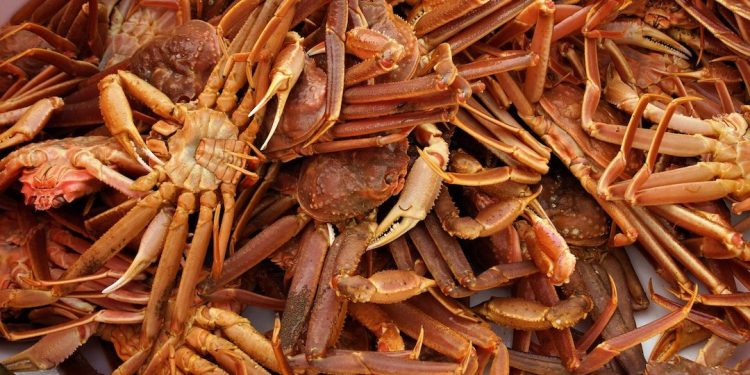





Norway’s Institute of Marine Research has advised that the 2026 quota for snow crab should not exceed 12,336 tonnes. This is a marginal reduction on its 12,725-tonne recommendation for this year’s fishery – which was a 2400-tonne increase compared to 2024.
‘Stock assessment shows that the stock is still in good condition and has stabilised at a higher level. Therefore, last year’s level is maintained in the quota council for 2026,’ said stock manager Ann Merete Hjelset.
The decision on the snow crab quota for 2026 will be set by the Ministry of Trade, Industry and Fisheries this autumn.
The quota for snow crab is fished during the spring, which is also the period when the crab is of the highest quality. The density of snow crab is greatest in the areas around the Central Bank, in the middle of the Barents Sea, where commercial fishing on the Norwegian continental shelf also takes place.
‘We observe no significant change in the distribution of snow crab compared to previous years. This may mean that the population is stabilising at a sustainable level after significant growth over the past ten years. Therefore, the quota advice for next year will be in line with the recommendation for 2025,’ she commented, adding the the Institute is also advising that the closed period from 1st July to 31st December should be maintained in 2026.
Once the snow crab has moulted, it becomes vulnerable to damage. The protection reduces the risk of damage from fisheries and contributes to reducing discarding.
‘This supports a more robust population, while ensuring that the fishery takes place during the period when the crab is of best quality, which reduces the need for sorting,’ Ann Merete Hjelset said.
The Institute also maintains its recommendation to introduce escape holes with biodegradable twine in crab pots, to as a preventive measure against ghost fishing in lost fishing gear.