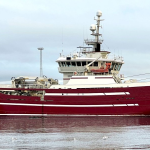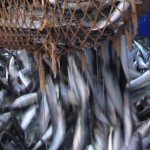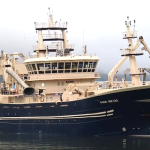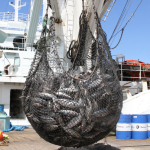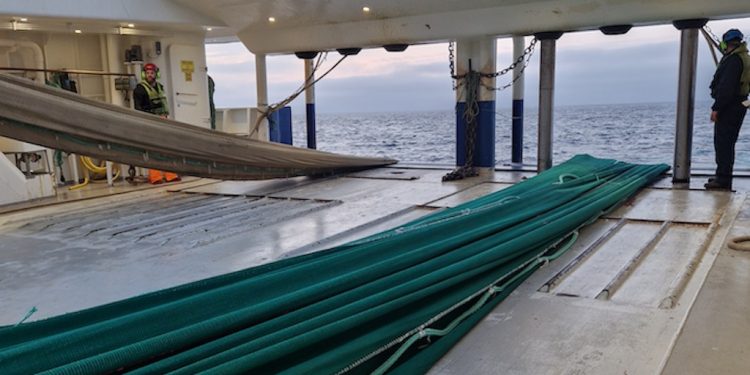





A flexible grid tested on board Norwegian pelagic trawler Cetus looks promising after being tried out for two trips on Norway pout.
The development work has been done by Egersund Trål and Institute of Marine Research. The project is partly funded by the Fisheries and Aquaculture Industry Research Funding (FHS) and the Directorate of Fisheries in Norway.

According to the report published by FHF, the flexible grid is effective in filtering out unwanted by-catches and it could have applications in other fisheries.
‘There are some challenges to handling the steel grid that we are required to use. It is easily damaged when we spool the trawl on board. It is heavy and is simply difficult to handle. With this flexible excluder, the work is much easier, and the by-catch is filtered out unharmed,’ said Helge Olav Vikshåland, owner of Cetus.
The two trial trips with the flexible grid have followed tank testing ashore.
‘We have a double rig, so we were able to work both a regular trawl and the test gear at the same time. That way we got a reference trawl so we could compare the catching operations,’ he said, commenting that this excluder design could be effective for other fisheries.
‘Absolutely. Unwanted by-catch is a challenge in many fisheries, so this is probably a method that can be further developed for other fisheries as well,’ Helge Olav Vikshåland said.
Whitefish is a problem for the Norway pout fishery, and if the by-catch exceeds acceptable levels, there is a possibility that fishing grounds can be closed.
The ball is now with the Directorate of Fisheries, which has to decide whether or not to allow the use of this new selection device.