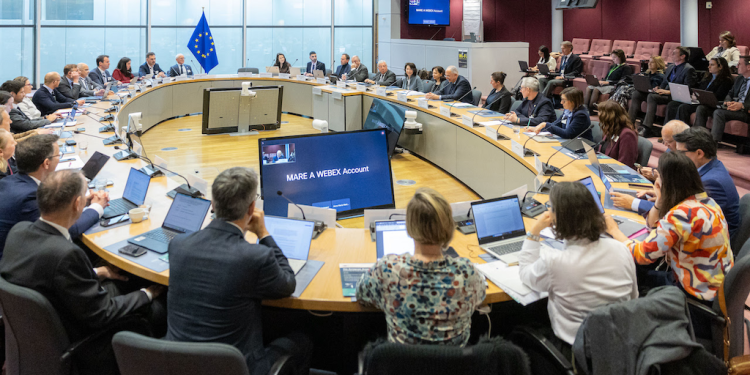



The inaugural meeting of the European Ocean Board convened a broad range of stakeholders from across sectors to support the implementation of the EU Ocean Pact.
As a full member of the Board, Europêche played a key role in conveying the perspectives of the fisheries sector into this cross-sectoral platform. Discussions highlighted the urgent need to improve coherence across policies and stakeholders, while ensuring that efforts deliver concrete and measurable outcomes.
Representing Europêche, Tim Heddema reinforced the point that fisheries are central to a sustainable ocean economy, contributing to food security, low-carbon protein supply and the vitality of coastal communities – while the sector continues to face mounting pressure from global crises, geopolitical instability and increasing regulatory burdens.

He commented that addressing these structural challenges requires immediate, targeted action, including the development of a Fisheries Omnibus to streamline multiple policy frameworks simultaneously.
Europêche highlighted the growing challenge of spatial squeeze, as increasing demands on maritime space put pressure on traditional fishing grounds, while there is a pressing need to recognise fisheries as a strategic activity of overriding public interest, ensuring fair access and positive coexistence between sectors.
In the context of ocean governance and diplomacy, outlined the need for a more assertive EU approach to safeguarding fisheries interests, ensuring a level playing field and reinforcing seafood sovereignty. He also highlighted the importance of investing in the future of the sector, notably through a Blue Generational Renewal Strategy to attract young professionals, and through continued efforts under the Energy Transition Partnership.
Europêche welcomed Commissioner Kadis’ call to accelerate action, reduce fragmentation, boost the blue economy and deliver tangible results, noting that these priorities point in the right direction.
‘Success is not just about adopting policies — it is about delivering real outcomes. Progress must therefore be assessed through concrete indicators such as fleet performance, production levels and socio-economic cost-benefit analysis,’ a Europêche representative stated.
‘Ultimately, the Ocean Pact will be judged on its capacity to deliver balanced results – meeting the growing demand for seafood, supporting coastal communities and reducing EU import dependency, while ensuring the preservation of marine ecosystems.’
Representing the European Economic and Social Committee (EESC), Javier Garat stressed that the new strategy must go beyond symbolic language. The strategy must deliver real solutions, rebuild trust and ensure inclusive governance supported by adequate investment. This includes stronger support for research, maritime skills, an action plan on blue foods, and attracting new generations into the fishing sector.