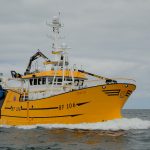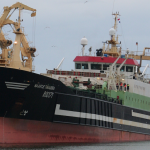





Fishermen in France are heading into a third consecutive winter shutdown of the Bay of Biscay’s fisheries, affecting vessels over eight metres fishing with a variety of gears. While the industry’s position is that this cannot continue, NGOs are pushing for more and longer shutdown periods.
In Brittany alone this third shutdown from 22nd January to 20th February affects more than a hundred fishing vessels.
While NGOs are calling for the fishery closures to be extended over several months of each year, CRPMEM Bretagne (the Brittany Fisheries Committee) warns that these demands are being made without addressing the underlying issue of cetacean bycatch – and that such drastic measures would lead to the irrevocable loss of local jobs and expertise and a worsening of France’s trade deficit and food dependency.
‘The preservation of dolphins requires targeted measures, not generalised closures that permanently weaken fishing without addressing the root causes of bycatch,’ said insists Olivier Le Nézet, president of CRPMEM Bretagne.
The committee is requesting that the Bay of Biscay fisheries be allowed to remain open during the winter as early as 2027, based on measures that reconcile maintaining fishing activities with the protection of cetaceans, stating that to address the increase in dolphin mortality, the decision was made to paralyse an entire socio-economic sector.
‘Even with compensation schemes, this decision destabilises local stakeholders, including artisanal fishers and professionals in the seafood trade and transport, solely benefiting foreign import channels,’ a committee representative stated, commenting that three years of research has resulted in the Delmoges report confirming that the increase in cetacean deaths from accidental capture observed since 2016 is primarily caused by warming waters, which forces them to follow the migration of their prey to winter fishing grounds.
‘The methods used by the Pelagis Observatory have recently revised the estimated mortality rate from capture downward by 23%. Similarly, the precise state of the dolphin population in the Bay of Biscay during the target period would be needed to determine the actual effectiveness of the closures,’ the committee states.
The industry has widely adopted precautionary measures, with more than a hunded fishing vessels (more than forty in Brittany) with cameras on board, while a variety of hull-mounted and gear-mounted deterrent devices are also in widespread use.