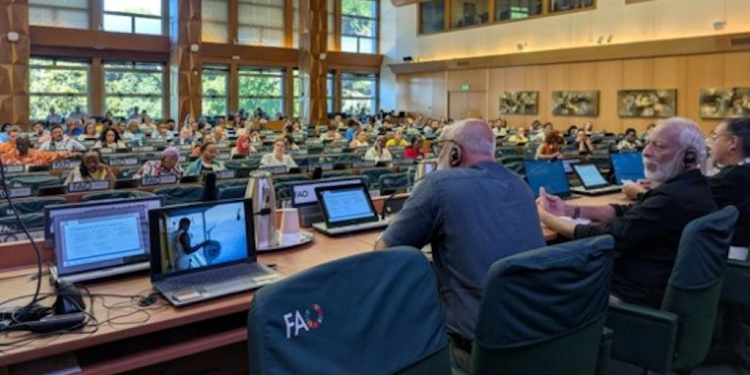





FAO director-general Qu Dongyu is under pressure to clarify comments made at the recent World Summit on Small-Scale Fisheries held in Rome, when he stated that we ‘certainly do not need more wild fish catches,’ and questioned the nutritional quality of wild fish, portraying fishing as an activity that is generally neither sustainable nor environmentally friendly, nor capable of generating sufficient income.
A joint statement was prepared in response within the framework of the International Planning Committee for Food Sovereignty (IPC) to express the concerns of fishing communities and Indigenous Peoples over the director-general’s comments, in which he also advocated for a more intensive and technologically advanced form of aquaculture, claiming this could produce more and faster than nature.
Delegates see this as a productivist vision that ignores the environmental and social impacts of industrial aquaculture, as well as the essential role of fishermen, their knowledge, and their territories.

According to the director-general’s remarks, the idea wild fish is better than farmed fish is, from a scientific point of view, ‘absurd,’ stating that wild fish grow too slowly and feed irregularly, unlike farmed fish the growth of which can be accelerated and controlled using artificial intelligence and digital tools, and which, he stated, could produce much higher incomes on a single hectare of fresh or salt water.
‘Hearing such remarks from the highest-ranking official of the FAO is extremely worrying. Hearing them at a summit specifically dedicated to artisanal fisheries is a real affront to the women and men who have depended on fishing for their livelihoods, feeding communities, and caring for aquatic ecosystems for generations. The fishermen present were not fooled. Many felt directly devalued and offended,’ a small-scale fishing representative commented.
‘Presenting accelerated fish growth and increased production volumes as progress in itself reflects a dangerously simplistic view of aquatic food systems. This approach ignores ecological limits, animal welfare, nutritional quality, the social and environmental consequences of industrial models, and the rights of communities that depend on aquatic environments. Nature is not a competitor that technology should surpass. It is the living foundation of our food systems, our cultures, our territories, and our livelihoods.’

The small-scale organisations point out that beyond the immediate outrage, this raises profound political concerns of how can small-scale fishers can have confidence in the international commitments made on their behalf when the FAO Director-General himself delivers speeches that devalue wild fish, capture fisheries, and community knowledge?
‘The FAO is the custodian of the Voluntary Guidelines for Sustainable Small-Scale Fisheries. It therefore has a particular responsibility: to advocate for their implementation, recognise the rights of fishing communities and Indigenous Peoples, and support food systems based on their knowledge, their territories, and their meaningful participation in decision-making,’ a stakeholder representative said.
‘An institution tasked with fighting hunger and supporting artisanal fishing cannot promote a vision that pits technology against nature, devalues wild fish, and presents industrialisation as the sole path to development. Fishermen’s organisations now expect a clear and public response from the FAO, commensurate with the affront they feel and the profound concern caused by these statements.’