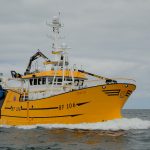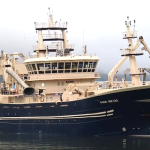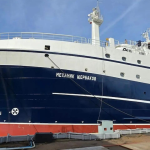
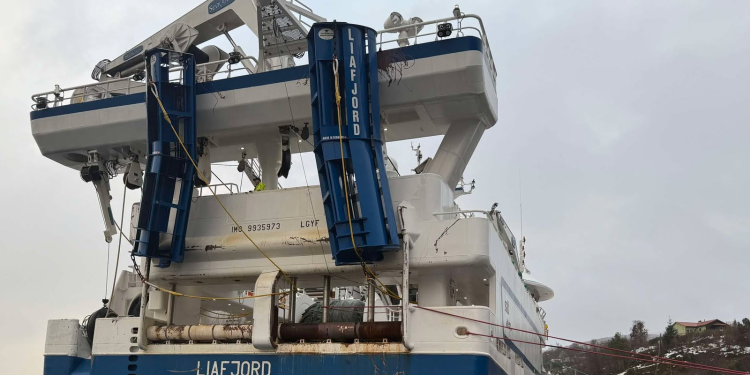




Pelagic vessel Liafjord has been fishing with a pair of controllable trawl doors from Thyborøn Trawldoor since the early part of this year, and skipper William Rabben has been wondering why taking this step took so long.
‘The question is, why didn’t we do this before?’ he said. ‘Liafjord was delivered in January 2024, and we could have been using these doors right from the start. They tried to convince us, but we decided against it at the time,’ he said, commenting that what tipped the balance was seeing others in the pelagic fleet using controllable technology successfully, and favourable reports from other skippers, including within the company as other Liegruppen vessels have experience of controllable trawl doors – from several manufacturers.
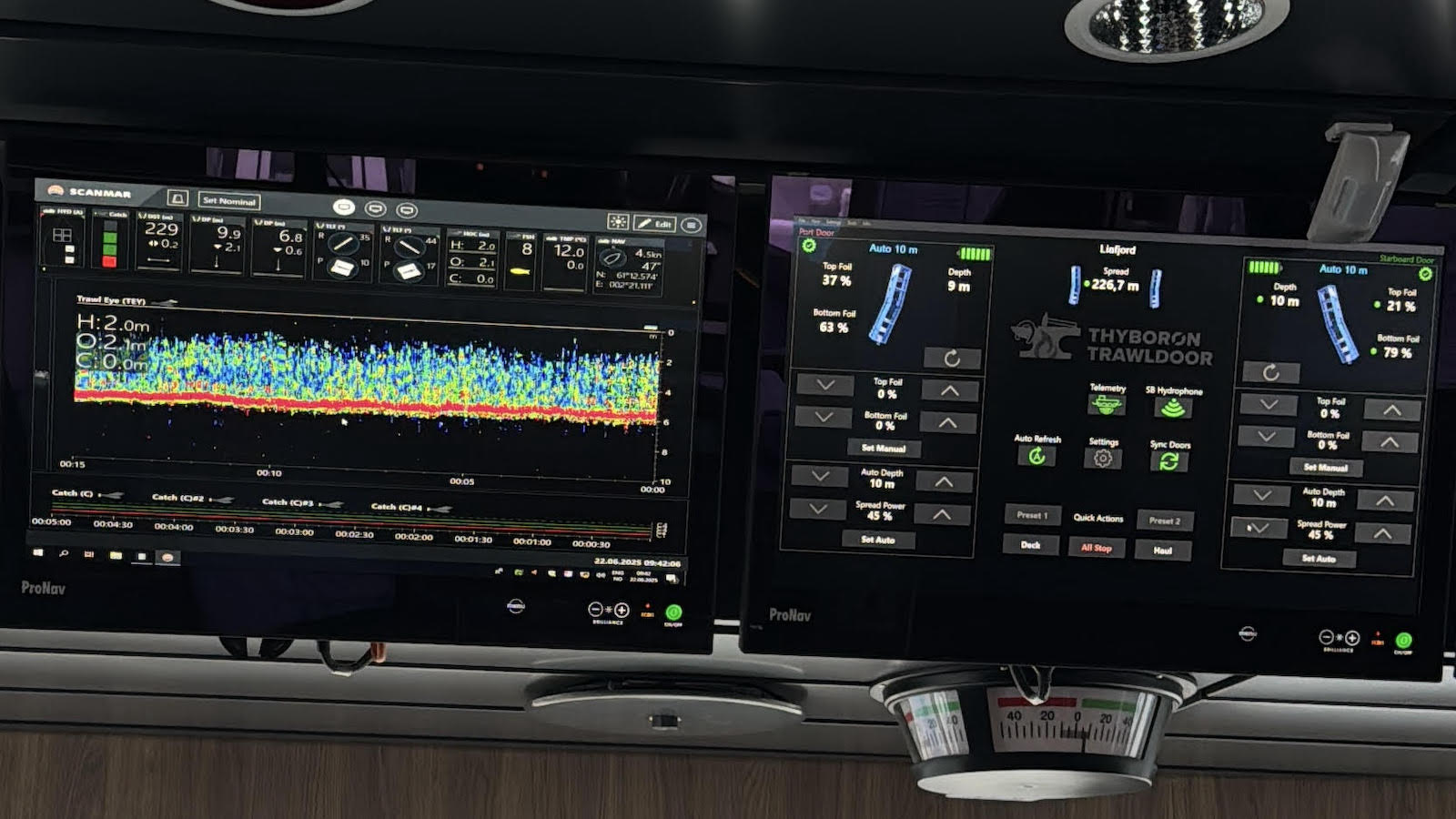
‘We’re super-happy with these doors,’ he said. ‘They make everything easier. The result is better fishing.’
So Liafjord got its own pair of Thyborøn Type 42 controllable doors in January this year, and they’re using the same pair of doors for every fishery. That’s herring, mackerel, blue whiting and silver smelt – and they’ll be using them on sandeel as well next year.
‘That’s if there’s a quota for sandeels in Norwegian waters,’ he said, and needs no more convincing of the advantages of controllable doors after using them across a variety of fisheries.
A major difference is that the doors function to sit at the depth required. For fisheries high in the water, this means that the inside door doesn’t drop in a turn while the outer door no longer risks hitting the surface.
‘We programme them for 10-15 metres below the surface, and they stay more or less at that depth the whole time and don’t break the surface,’ he said.
This keeps the trawl gear in its ideal fishing configuration, and the same applies in deep water, with the doors working to maintain their set position.

‘On blue whiting in the area between the UK and the Faroes, there are often very strong tidal flows and sometimes there can be a difference of a hundred metres in the depth of the doors. If one is at 400 metres and the other at 500 metres, then the gear is skewed. But this doesn’t happen with controllable doors as they tune themselves to follow the depth.’
The Thyborøn doors have also proved their value on silver smelt in the far north, a fishery that’s tight to the bottom.
‘I regret that we didn’t get doors with down sounders that would track the seabed. But it means we just have to adjust the depth setting of the doors during a tow. This will also make a difference for fishing sandeel, as this makes it easier to lift the gear to avoid a haddock by-catch, and this has been a problem,’ he said.
‘These doors make everything easier. If you’re fishing on the surface and the weights aren’t quite right, you can adjust the doors to compensate. If there’s a lot of weight in the gear, you can increase the spread to keep the trawl where you want it. This isn’t experimental gear any longer,’ he said, commenting that there was no learning curve when these were delivered and the doors have performed exactly as required from day one.
‘The software is intuitive and easy to use. When the doors were delivered we had technicians from Thyborøn on board for a few hours to fine-tune them, and since then we haven’t changed anything. These doors are used with all of our gear, and the only alteration is that we adjust the warp attachment point if we’re going to deep water, which makes it easier for the doors to work,’ he said.
‘There have been few problems – normally been down to “user issues”, and easily solved,’ he said
‘A lot of Norwegian pelagic vessels are investing in controllable doors and this is set to become standard gear. All of the skippers are happy with the controllable doors they are using.’
‘We have a drop sonar with the hydrophones for the doors and the Scanmar system mounted in the same unit. This places them 1.6 metres below the keel, so it’s free of propeller noise and we get a very clear link to the doors. Command and response is very quick and I’m impressed with the accuracy,’ William Rabben said.
‘Being out of power has never been an issue. We never go below 50% battery power, even with long tows of 12-14 hours. I’m sure we could to wfor 24 hours on a charge if we wanted to. Charging is fast, 20 minutes and you have full power,’ he said, commenting that battery usage depends on how hard the doors work. ‘They’re very stable once they find their depth.’