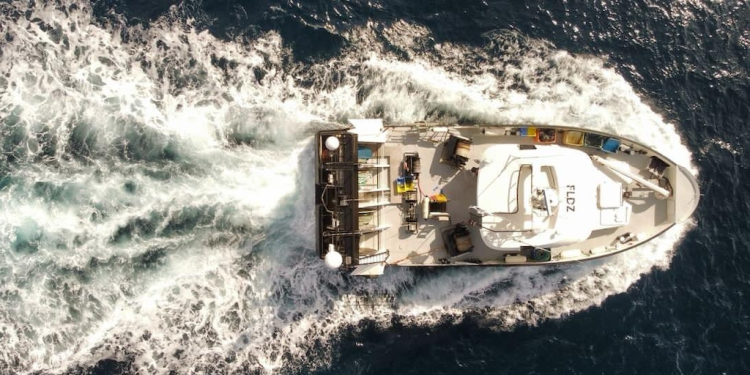





Fuel prices are struggling to recover following the conflict in the Middle East, and those involved in the fishing industry in Brittany are already looking to the future. While there is no magic bullet to free fishing vessels from their dependence on fossil fuels, the French industry is working on transitional solutions to gradually reduce consumption.
‘The major crises suffered by the fishing industry in recent years have all been triggered by soaring diesel prices. We absolutely must break out of this spiral. The idea is to invest in our equipment not to fish more, but to fish better,’ argue industry representatives.
In Lorient, in partnership with the CRPMEM Bretagne (Regional Committee for Maritime Fisheries and Aquaculture of Brittany), the Keroman company Apak has been engaged since 2022 in the development of a hybrid propulsion system through the HYBA project, the second phase of which is now underway.
After studying and modelling the operational characteristics of 22-metre fishing vessel Naoned, using approximately 80 sensors, the next step is to equip it with a battery pack by 2027. Fuel savings of 22 to 25% are expected.
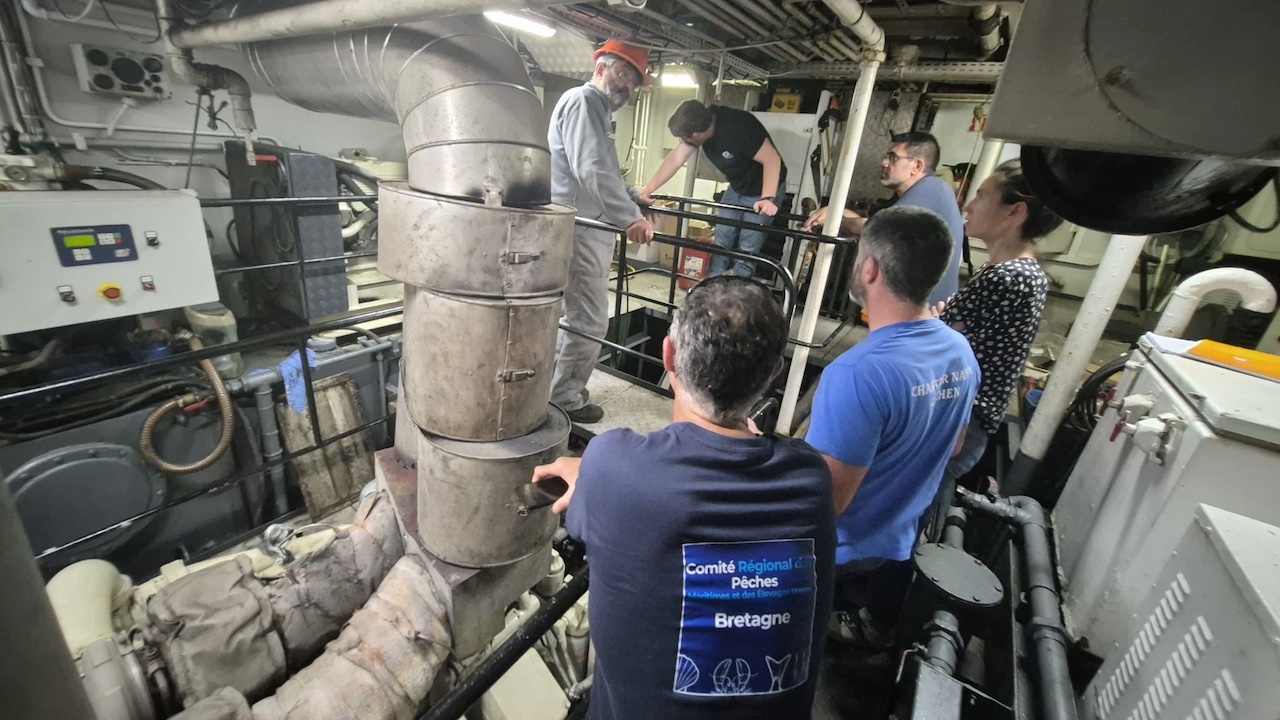
At the same time, another Apak vessel, Dolmen, will also be deployed to implement innovative technical solutions, systems, and onboard sensors to optimise operation (fuel consumption) and engine speeds, as well as the hydrodynamics of the fishing gear. The expected gains are in the range of 12 to 15%, representing a saving of 42,000 liters of fuel and 112 tonnes of CO2.
Apak is also developing a digital decision support platform with the HYO (halieutics yield optimiser) project, in order to better anticipate vessel trajectories, marketing and the valorisation of catches.
In Guilvinec, still in partnership with the CRPMEM Bretagne, 17-metre trawler Magellan II is completing a major refit. Via the SIRENE project, this incorporates a key innovation for the energy transition of the fishing industry – the Ecopro system supplied by Laminak Energy. This system produces and injects micro-quantities of hydrogen into the engine to improve fuel combustion.
‘One thing is certain – substantial savings will likely come from combining a wide range of technologies, a CRPMEM representative commented.
‘In this respect, genuine support from public authorities and government agencies is essential. Moving forward with decarbonisation requires evolving regulations to implement tomorrow’s solutions, particularly by removing obstacles to modernisation and construction.’