



The Federated States of Micronesia (FSM) are taking a lead in transparency and compliance in tuna fisheries management with strengthened Port State Measures (PSM).
The National Oceanic Resource Management Authority (NORMA), with technical support from a fisheries advisor funded by the New Zealand Ministry of Foreign Affairs and Trade (MFAT), is strengthening the FSM’s commitment to sustainable fisheries by implementing more rigorous Port State Measures (PSM) to combat IUU fishing. These initiatives align with FSM’s international fisheries obligations and highlight the nation’s leadership in promoting transparency and compliance in tuna fisheries management.
‘NORMA’s strengthened port state measures are a vital step in safeguarding FSM’s fisheries resources and upholding international commitments,’ said Rocco Samuel, Assistant Director, Compliance Division.
‘By integrating advanced risk analysis and data-driven decision-making, we are reinforcing our ability to detect and deter IUU fishing activities before they enter our ports. FSM’s improved PSM framework not only guarantees compliance but also backs international initiatives to promote responsible and sustainable fisheries management in the Western and Central Pacific Ocean.’
The mandatory notification of a fishing vessel’s arrival at any of the FSM fisheries ports through the Forum Fisheries Agency’s (FFA) electronic Port State Measures (ePSM) system triggers a sequence of events and requirements that must be understood, managed, and controlled until the vessel departs. This sequence is what NORMA refers to as PSM procedures.
As part of these improved procedures, every incoming fishing vessel – including FSM-flagged vessels – will undergo a risk assessment designed to identify potential non-compliance in three key areas. These centre around Identity – verifying the vessel is who it claims to be, Manoeuvring – assessing the vessel’s recent activities and ensuring operations were accurately reported, and Licensing – confirming the vessel’s operations were authorised in the identified fishing locations.
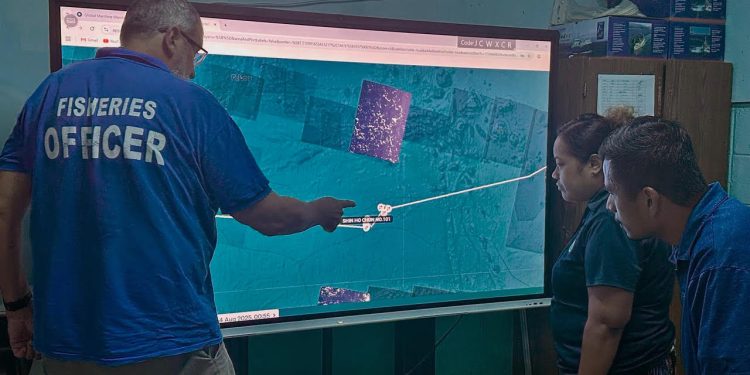
NORMA officials conduct these risk analyses to evaluate the legality of catches and oversee carriers’ activities beyond transhipment and landing operations. These assessments utilise advanced tools and intelligence from FFA VMA, the Starboard Maritime Intelligence platform, FFA’s Regional Information Management Facility (RIMF), and FSM’s Integrated Fisheries Information Management System (iFIMS).
Compliance officers review critical data, including Vessel of Interest (VoI) lists, risk indices, VMS tracks, licensing records, electronic forms, and observer reports.
Where concerns are identified, NORMA will decide whether to join the Border Control & Maritime Surveillance (BCMS) officers-led boarding team to carry out an investigation if needed, before granting the right to tranship or discharge. All decisions, including direct port use approvals, are communicated via the FFA ePSM system, guaranteeing a transparent and secure process.