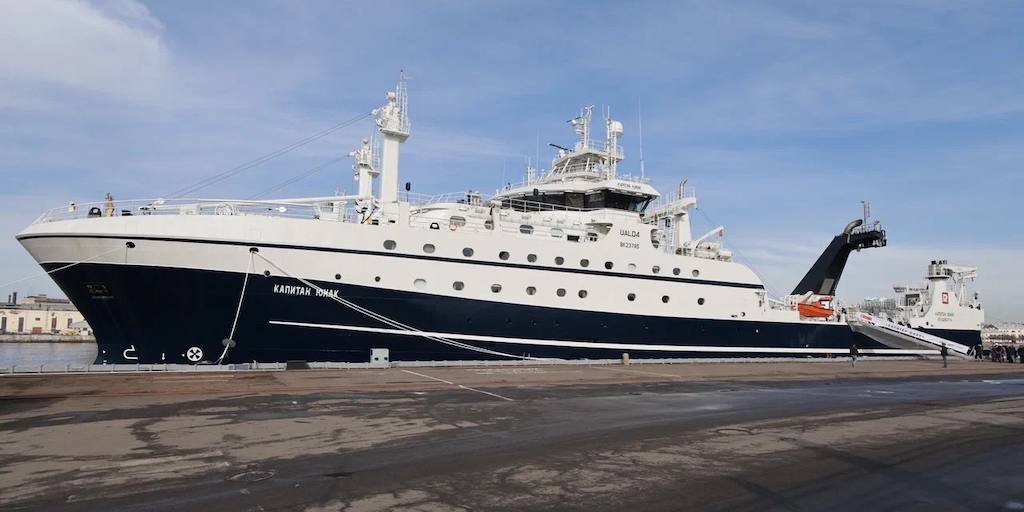
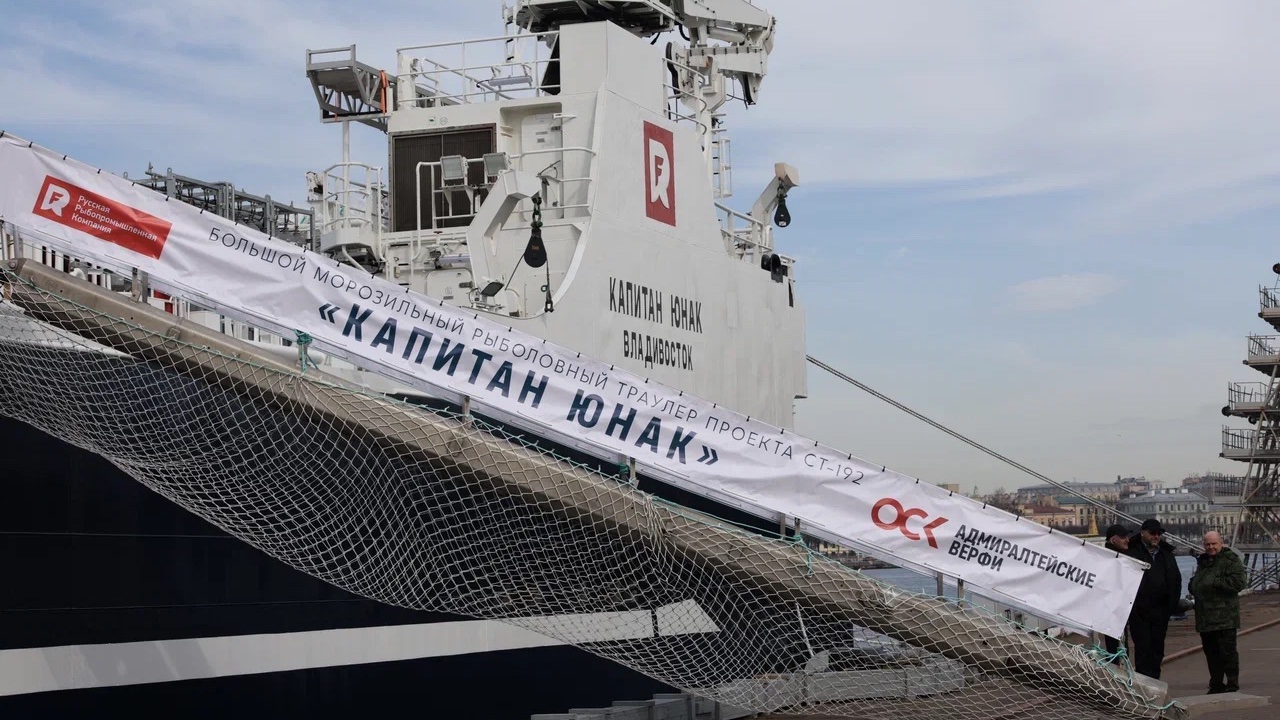
The fifth in the series of new trawlers built for the Russian Fishery Company has been handed over to its owners by the Admiralty Shipyards in St Petersburg.
Kapitan Yunak’s keel was laid in June 2021 at the yard and its launch took place in September 2024. These 108-metre ST-192 trawlers are designed for fishing pollock and herring in Russian Far Eastern waters and each of the series of nine built in St Petersburg plus a lead vessel built in Turkey is expected to handle around 60,000 tonnes of raw material annually.
The emphasis is on efficient processing and freezing, producing fillets, minced meat, surimi, fish oil, pollock roe, and fishmeal. Expected daily production capacities are for 60-80 tonnes of fillets and up to 40 tonnes of meal produced from processing offcuts and offal, or around 80 tonnes of surimi mince.
This production capacity is roughly 2.5 times greater than of the elderly trawlers that the company is replacing with new capacity.
‘Kapitan Yunak is a prime example of how government support mechanisms and private investment can work together to create a world-class project. It’s a great honor to be the godmother of this vessel, which is rightfully considered one of the most modern and technologically advanced supertrawlers,’ said First Deputy Minister of Finance Irina Okladnikova.
‘We’re not just expanding the Russian fleet but also developing regional economies and creating new jobs.’
In keeping with tradition, the new vessel is named in honour of a respected industry figure, in this case Vladimir Mikhailovich Yunak (1948-2008). His son, AV Yunak, who has continued his father’s work as senior engineer at RFC, was present at the handover ceremony, along with a host of senior industry and government figures.
RFC chairman Saveliy Dmitrievich Karpushin commented that after taking delivery of the first trawlers in the series, Kapitan Yunak has proved to be a challenge.
‘Kapitan Yunak is a unique vessel in the series. It has had the most difficult time,’ he said. ‘It was with this vessel that we encountered unprecedented pressure, with the refusal to supply equipment by our European partners. But it was largely thanks to the talent, skill, and engineering excellence of the Admiralty Shipyards that we overcame the challenge.’