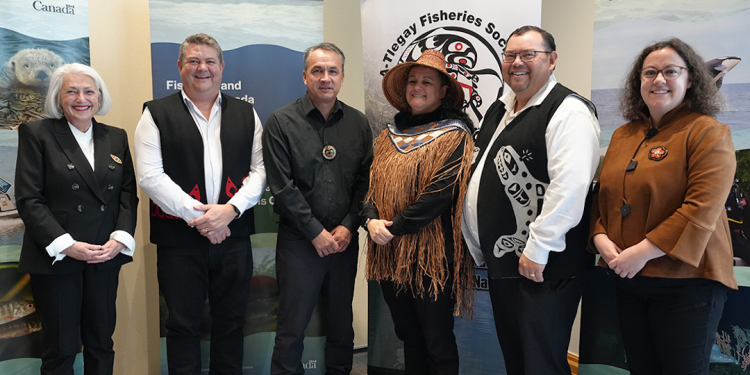




The Government of Canada, represented by Minister of Fisheries Joanne Thompson, and Minster of Crown-Indigenous Relations Rebecca Alty have signed a historic 20-year Reconciliation Agreement for Fisheries Resources (RAFR) with the A-Tlegay Member Nations.
The RAFR will enable A-Tlegay Member Nations to acquire commercial fishing licences and quotas through an open-market process. The RAFR will also provide support for growth in sustainable shellfish aquaculture, as well as facilitate other opportunities, such as training and business development in commercial fishing. The RAFR also includes a commitment to establish a collaborative fisheries management governance structure with Fisheries and Oceans Canada.

The Member Nations are represented by Hegus Nicole Rempel, K’ómoks First Nation, Chief Steven Dick, Kwiakah First Nation, Chief Danial Smith, Tlowitsis Nation, Chief Ronnie Chickite, We Wai Kai Nation, and Chief Christopher Roberts, Wei Wai Kum First Nation.
‘The A-Tlegay Member Nations have been managing these fisheries for a long time. This agreement recognizes that, creates real economic opportunity, and puts a collaborative governance structure in place to support the work going forward,’ said Joanne Thompson.
The RAFR is an agreement aimed at supporting diversification and economic development of the A-Tlegay Member Nations.
In the spirit of reconciliation between the A-Tlegay Member Nations and Canada, the RAFR will enable a more collaborative, coordinated and efficient approach to the governance and management of fisheries resources, including associated economic opportunities.
The traditional territories of the A-Tlegay Member Nations span the central northeast coast of Vancouver Island and include the northern Strait of Georgia and the Johnstone Strait. These waters support extensive marine activity including commercial, recreational and First Nation Fisheries, commercial aquaculture, marine shipping, recreational boating, and commercial whale-watching.
‘This agreement reflects meaningful progress in our work with the A-Tlegay Member Nations. I want to congratulate all Member Nations on reaching this important milestone. This historic agreement not only supports advancing Canada’s relationship with the Nations but also creates new opportunities in fisheries grounded in collaboration, partnership, and mutual respect,’ said Rebecca Alty.
‘Our fisheries have sustained each of our Nations for generations, and we have endured as our long history of sustainable fisheries management has been disrupted in the last century,’ the A-Tlegay Member Nations state.
‘This Agreement will support us in building upon the considerable track record of the A-Tlegay Fisheries Society in fisheries governance and management and to re-establish the important balance between economic opportunities and stewardship. This Agreement will provide us with additional capacity to continue to build our fisheries economies, to diversify, and to bring economic benefits to our Nations and to the region. We are committed to working with our Members, with DFO and with our partners to create sustainable fishing opportunities for present and future generations and to be a long term driver of our regional economies.’
The A-Tlegay Member Nations currently manage a fleet of commercial fishing vessels through the A-Tlegay Fisheries Society and are actively involved in fisheries management.