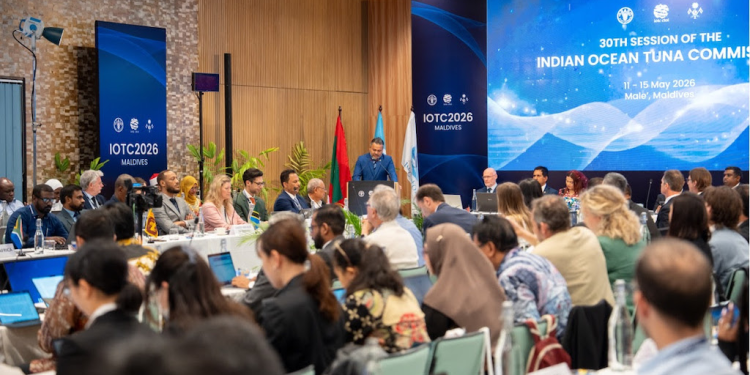





This outcome on yellowfin tuna at the 30th Session of the Indian Ocean Tuna Commission held in the Maldives marks a major step forward for long-term sustainable fisheries management in the Indian Ocean. According to Europêche, it also reinforces fairness and accountability among fleets operating in the region.
This is a first, with the IOTC allocating yellowfin tuna TAC and quotas among members, becoming the first tuna RFMO to establish TAC and quota systems for all three tropical tuna stocks. The session concluded with the adoption of eight conservation and management measures.
The IOTC agreed on a yellowfin tuna TAC of 436,867 tonnes for 2027 and 2028, close to the historical MSY range identified by scientists and significantly below the current catch level of 489,742 tonnes, while bringing major long-term objecting CPCs back into the management framework. This step should soon be complemented by the Scientific Committee’s ongoing work towards the adoption of a management procedure.
‘The European Union has been working hard to both preserve the green status of the yellowfin tuna stock and ensure a level playing field for the European fleet. The EU quota was preserved while allowing substantial coastal states’ fisheries development, key objecting parties were reintroduced within the allocation framework, and Oman committed to withdraw its objection on drifting FAD management measures, strengthening the robustness of the whole system,’ said Europêche Tuna Group president Xavier Leduc.
The session also allocated swordfish among IOTC’s members, ensuring the TAC will not be overshot, and delivered improvements on bycatch mitigation measures for Mobula rays. Important advances were achieved in monitoring, control and surveillance measures. CPCs agreed on strengthened statistical reporting obligations for fishing vessels, including coastal fleets’, tighter limitations on at-sea transshipments, allowed only between IOTC members, and a first step towards better inclusion of vessels below 24 metres in the IOTC record of authorised vessels.
The Commission also adopted a measure linked to the implementation of the Biodiversity Beyond National Jurisdiction (BBNJ) Agreement, reaffirming IOTC’s mandate and expertise in fisheries management and ensuring regional fisheries bodies remain central actors in the governance of marine resources and conservation.
‘To complete those positive results, we hope that the European Union will also ensure a level playing field on the market side by limiting Indonesia’s duty-free tuna fillets access under the draft CEPA to compliant products only, notably regarding IUU fishing, sanitary standards and forced labour requirements,’ Xavier Leduc said.
The new yellowfin tuna management framework, which moves the stock from a recovery plan to a long-term management plan, also opens the door to replacing ageing supply vessels instead of requiring their permanent withdrawal from the European fleet. This long-awaited flexibility is essential to improve maritime safety, crew welfare and generational renewal while preserving employment in the sector.
At the same time, discussions on social standards highlighted the importance of ensuring coherence with internationally recognised labour frameworks. A report presented during the session confirmed that absolutely all current RFMO provisions on labour and social standards remain below the requirements established under the ILO Work in Fishing Convention (C188).
Europêche stressed that efforts undertaken within IOTC should support and reinforce existing international instruments developed by the competent organisations, notably the ILO, rather than create parallel standards that could result in lower or inconsistent levels of protection for fishers.
‘The EU proposed that the IOTC socio-economic Working Party evaluate how to better improve social and labour standards within IOTC, while both the EU and France highlighted the need for IOTC members to ratify ILO Convention 188,’ stated Europêche Tuna Group director Anne-France Mattlet in an intervtion on the floor as a reminder of its common position with the European Transport Workers Federation as social partners.
‘We hope this will lead to broader ratification, strengthening the role and scope of the International Labour Organisation in fisheries, without lowering social standards through the adoption of resolutions that would fall into the trap of insufficient protections.’