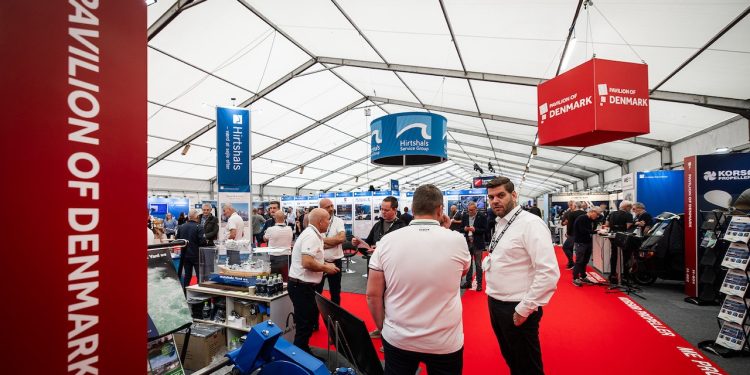




When DanFish International brings together the fishing industry and maritime industry from around the world for the 29th time at the Aalborg Congress & Culture Center, 7-9th October, there’s not only be a focus on sustainability among the exhibitors, but also in the actual running of the event.
As one of the world’s leading trade fairs for the commercial fishing and maritime industry, DanFish International attracts thousands of exhibitors and visitors from all over the world. And when the fair returns to the city, it will be with a greater focus on green transition in both content and logistics.
‘As a venue, we have a responsibility to push the green transition – not only in the content of our fairs, but also in the way we run them. That is why we are constantly working to incorporate sustainability into everything from transport and energy consumption to waste management and material selection,’ said director Nicolaj Holm.
This year there’s a collaboration with public transport provider Nordjyllands Trafikselskab (NT), which gives fair participants the opportunity to travel free of charge by bus and train throughout NT’s area.
‘We want to take responsibility for the overall CO2 emissions associated with a large, international trade fair like DanFish. That is why we are extremely pleased with the collaboration with NT, which gives both exhibitors and guests a real opportunity to reduce the impact of their transport choices,’ said the centre’s commercial manager Lars Rønnov.
A further step in responsible operation concerns the energy in the exhibition halls. A large part of DanFish takes place in AKKC’s mobile hall, which was previously heated exclusively with diesel. This year, it will be done with a new solution, where 90% of the heating is provided with electricity and only 10% with diesel. This means a significant reduction in the CO2 footprint from the exhibition facilities.
Waste gets graded into at least 25 categories behind the scenes during DanFish, and all exhibitors and visitors are encouraged to take responsibility for their own sorting and waste minimisation at the stand.
As the fair closes and the stands are packed up, the used fair carpets are not just thrown away – instead, local citizens and stakeholders have the opportunity to pick them up and give them new life in workshops, garages or creative projects. Along with the many sustainability initiatives, Aalborg also feels the economic value of DanFish. With thousands of international visitors, the fair contributes to a direct derived effect of at least DKK39 million to the city through, among other things, hotel stays and restaurant visits.
‘For us at the Aalborg Congress & Culture Center, sustainability is not only about climate, but also about social and economic responsibility. That is why we are proud that DanFish is both pushing for the green transition in the industry – and at the same time making a strong contribution to the local area,’ Lars Rønnov said.