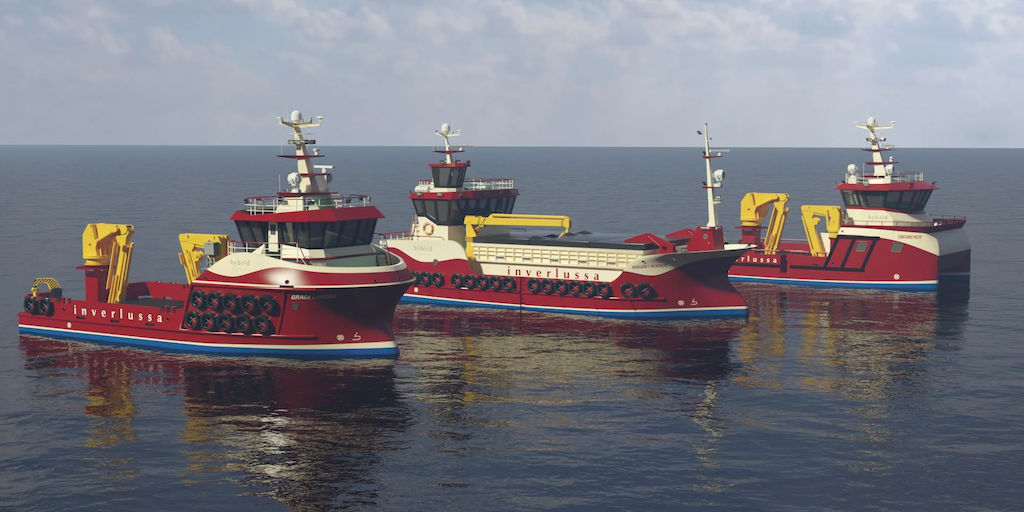
Inverlussa Marine Services has signed contracts for three new hybrid vessels, aiming to expanding its fleet and strengthen support for customers across Scotland.
Orders have been placed for three new vessels with three UK yards, and all three have been designed by Macduff Ship Design in close collaboration with Inverlussa. This substantial investment underscores Inverlussa’s commitment to the Scottish aquaculture sector and to operating a modern, efficient and environmentally responsible fleet.
Once delivered in summer 2027, the three new vessels will expand Inverlussa’s fleet to 25 vessels. Each of the new vessels will feature battery-hybrid capability and IMO Tier III engines, delivering lower emissions and improved fuel efficiency compared with earlier generations. All cabins will include private en-suite WC and shower facilities, reflecting the company’s focus on high-quality accommodation for crews.
The investment is expected to create around 20 new jobs, supporting employment and skills development in Scotland’s coastal communities.
‘We will continue to invest in the latest vessels, technology and our crew to maintain our position as a market leader in Scotland. As a family-owned business with a long-term outlook, we can make decisions that prioritise our customers, crew and the long-term success of the business rather than focusing on short-term shareholder returns,’ said Inverlussa Marine Services managing director Ben Wilson.
‘We believe one of the strengths of Scottish aquaculture is its commitment to working with local marine companies such as Inverlussa, helping to support jobs, investment and the sector’s social licence in coastal communities.’
Following the successful delivery of Naomi Jennifer in 2025, Inverlussa maintains its working relationship with Macduff Shipyards by placing a further order for a 20×12-metre heavy service catamaran.
A second 25×10.6-metre heavy service vessel is under construction with Nauplius Workboats, marking the fifth vessel Inverlussa has developed with the yard.
For its 27×11-metre fish feed carrier with a 400-tonne hold capacity, Inverlussa is for the first time working with Parkol Marine Engineering.
‘This is a very welcome investment and another sign of confidence in the future of Scottish salmon farming. These new hybrid vessels show how innovation is helping to reduce emissions, improve efficiency, and support responsible growth,’ said Salmon Scotland chief executive Tavish Scott.
‘Scottish salmon already has a low carbon footprint, but farmers and their suppliers are constantly looking for ways to go further. This kind of investment supports jobs and skills in coastal communities, while strengthening the businesses that help make Scotland a world-leading producer of salmon.’