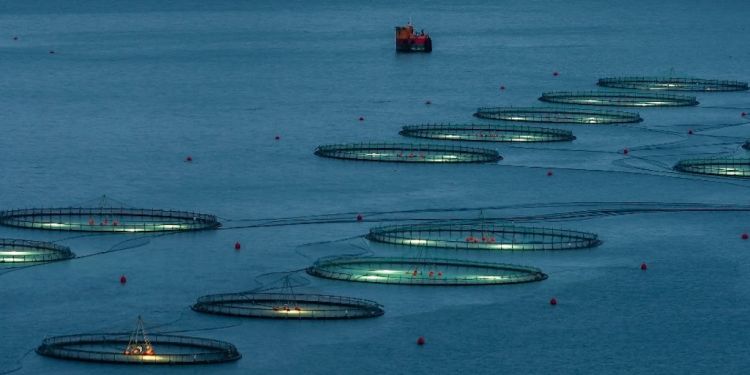




Faroese producer Bakkafrost has become the first Atlantic salmon producer to have farms certified against the Aquaculture Stewardship Council Farm Standard, marking an important milestone in the transition of the salmon sector to ASC’s global framework for farm certification.
The company has chosen to adopt the ASC Farm Standard well ahead of the transition deadline. Three Bakkafrost locations in the Faroe Islands have now achieved certification against the Farm Standard, and the company is progressing the transition of its remaining farming sites in the Faroe Islands and in Scotland.

This builds on more than a decade of ASC certification at Bakkafrost. Its Gøtuvík farm became the first ASC-certified salmon farm in the Faroe Islands in 2015. In April 2026, the Group announced that 100% of its salmon farming operations in the Faroe Islands and Scotland were ASC-certified.
‘This is an important milestone for Bakkafrost and our farming organisation. The ASC Farm Standard offers a broader, more integrated framework for managing environmental performance, fish health and welfare, social responsibility and operational risks,’ said Bakkafrost Group QESH Director Anna Johansen.
‘Our long experience with ASC certification and established management systems gave us a strong foundation for meeting the requirements. The transition has also helped us strengthen our systems, improve transparency and establish a clearer basis for measuring performance and driving continuous improvement.’
The ASC Farm Standard marks a significant evolution in aquaculture certification, bringing ASC’s species-specific farm standards together into one rigorous, science-based framework.
For the salmon industry, the Farm Standard strengthens requirements for fish health and welfare, including handling, disease prevention and treatment use. It also maintains restrictions on siting in protected areas and introduces a tiered approach to seabed-impact monitoring, alongside strengthened requirements for sensitive water bodies and data sharing.
The Farm Standard also strengthens social requirements covering workers’ rights, health and safety, and community impacts. By combining these requirements within a streamlined framework that can be applied across species and farming systems, the Farm Standard provides a consistent basis for measuring performance and driving improvement across aquaculture.
It places a strong emphasis on documented risk management, measurable performance, clear responsibilities, transparency and continuous improvement. For established ASC-certified salmon producers such as Bakkafrost, the transition builds on existing certification while requiring farms to demonstrate their performance against this integrated set of requirements.
‘As an early adopter, Bakkafrost has invested significant time and effort in working through the transition, and we recognise the commitment this has required. Their experience has also been invaluable for ASC, giving us practical insights into how the Farm Standard is implemented within an established salmon farming operation and where we can continue to improve the transition process,’ said SC CEO Chriss Ninnes.
‘This is the kind of collaboration that helps make a global standard work in practice. Bakkafrost’s experience will provide important learnings as more salmon producers begin their transition.’